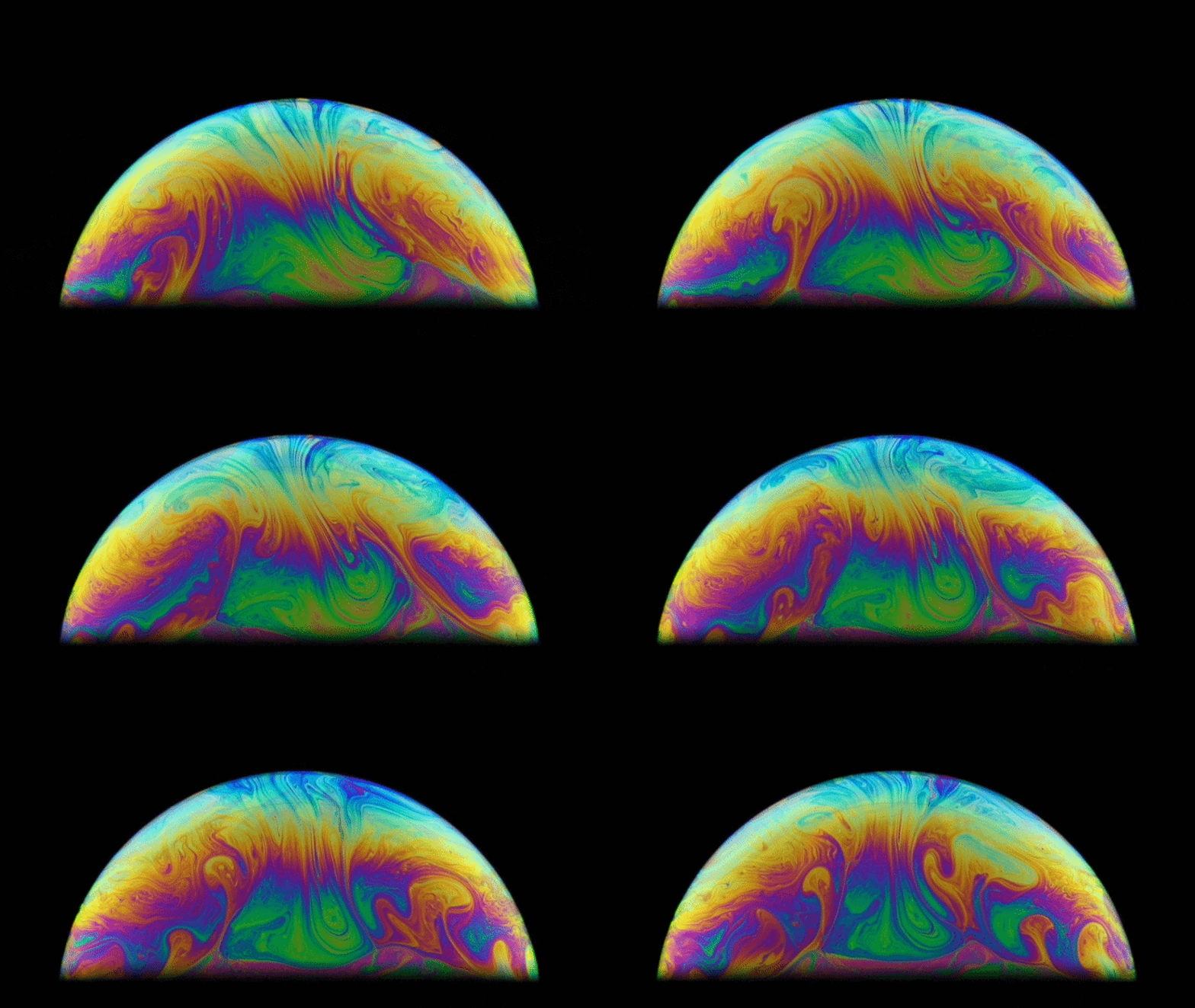
OpenAI announced that its artificial intelligence system has solved a centuries-old mathematical challenge involving the Navier-Stokes equations, which describe how fluids move. The accomplishment addresses one of seven Millennium Prize Problems, carrying a $1 million reward. The company’s AI agents worked for approximately 88 hours, ultimately discovering mathematical singularities—points where the equations theoretically produce infinite values—using a technique called smooth forcing.
However, the breakthrough has sparked controversy within the mathematics community. Mathematician Tristan Buckmaster claims that OpenAI may have obtained unfair advantage by learning about his concurrent research on the identical problem. Buckmaster and colleague Levent Alpöge were pursuing the same smooth-forcing strategy independently. After hearing about their progress, OpenAI launched its own effort on the same problem, according to Buckmaster’s allegations. He questioned whether OpenAI accessed his work through the Codex tool, which he had used to store research drafts, and reported being pressured to exclude Alpöge from credit negotiations during a contentious September meeting.
OpenAI leadership has denied the allegations, with CEO Sam Altman stating the company’s approach differs from Buckmaster and Alpöge’s work. However, OpenAI acknowledged learning of the researchers’ progress beforehand. The company credited both mathematicians in its announcement and offered co-publication. Prominent mathematician Terence Tao expressed concern that competitive AI efforts could discourage future scientific collaboration, potentially damaging open science traditions.
The work remains subject to formal peer review, and the Clay Mathematics Institute has not yet officially validated the proof. The episode raises important questions about data ownership and the future role of artificial intelligence in mathematical research.
Originally reported by Livescience →
About the Author