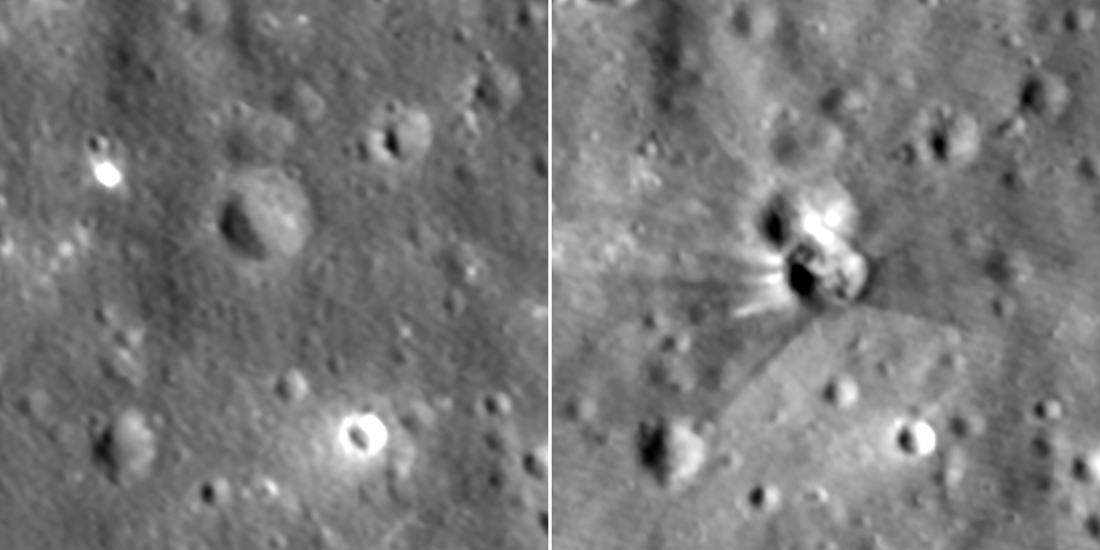
NASA has released photographs documenting the lunar impact site created when a SpaceX Falcon 9 rocket stage collided with the moon on August 5. Images captured by the agency’s Lunar Reconnaissance Orbiter between August 11 and 12 reveal a crater measuring approximately 60 feet across, with surrounding debris patterns visible across the lunar surface. The upper stage of the rocket, which launched in January 2025 to deliver lunar landers, had been orbiting Earth for nearly a year before gravitational forces and solar radiation redirected it toward the moon.
Locating the impact site presented significant challenges for researchers, requiring collaboration between astronomers and space agencies worldwide. The collision occurred near Einstein crater on the moon’s northwestern edge, in a region that faced away from Earth at the time of impact, making visual confirmation impossible from ground-based observations. Additionally, the rocket stage struck the surface at approximately 5,400 miles per hour—considerably slower than typical meteorite impacts, resulting in a proportionally smaller crater that was difficult to detect.
South Korean lunar orbiter Danuri first captured images of the blackened crater on August 6, with NASA’s detailed photographs following days later. Scientists used the Lunar Reconnaissance Orbiter’s high-resolution camera to measure the crater’s depth at less than 10 feet and analyze radiating streaks of lunar material ejected during the collision. The lighter and darker debris patterns reflect different layers of the moon’s subsurface, providing researchers with valuable information about the lunar geology at the impact site.
Originally reported by Livescience →
About the Author