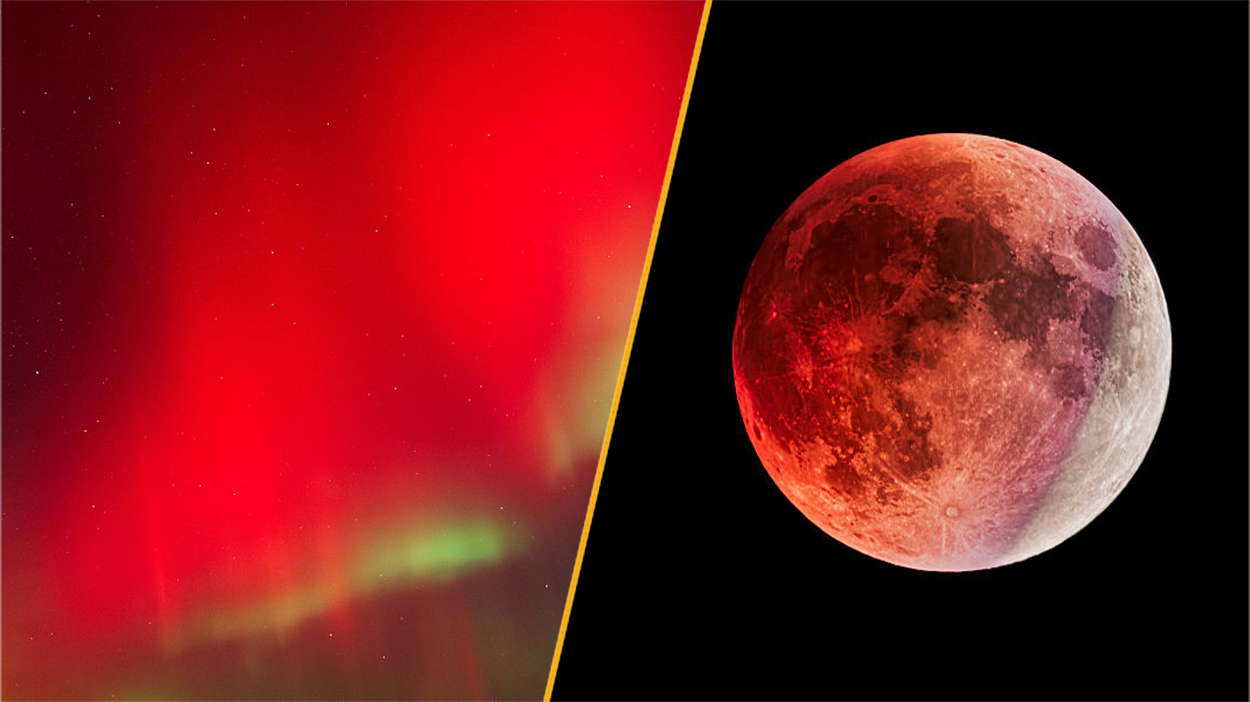
Stargazers have a rare opportunity this week as a partial lunar eclipse coincides with potentially visible red auroras on August 27-28. The moon will pass through Earth’s shadow, casting a crimson glow across 96 percent of its surface while a moderate geomagnetic storm sweeps across the planet, creating conditions favorable for witnessing the northern lights simultaneously.
A powerful solar flare and subsequent plasma ejection from the sun are expected to reach Earth during the eclipse window, triggering geomagnetic disturbances that could produce auroras visible across a wide region from New York to Idaho. Observers in Canada and Alaska stand the best chance of witnessing both phenomena together, though the moon and aurora may not appear in the same section of sky. The eclipse begins at 9:23 p.m. EDT, peaks after midnight, and concludes around 3 a.m. EDT on Friday.
The eclipse will be the deepest partial lunar eclipse visible worldwide until 2028, with the moon’s unusual dimness working in aurora hunters’ favor. Normally, a bright full moon competes with auroras by illuminating the sky, but an eclipsed moon will be relatively dark, enhancing visibility of the northern lights’ distinctive green bands.
The moon’s reddish appearance results from Earth’s atmosphere bending red light toward the satellite, while rare red auroras occur when solar wind particles collide with oxygen molecules high in the atmosphere, above 120 miles altitude. This atmospheric interplay could create a striking visual display combining the copper-red moon with emerald-hued auroral arcs.
Originally reported by Livescience →
About the Author