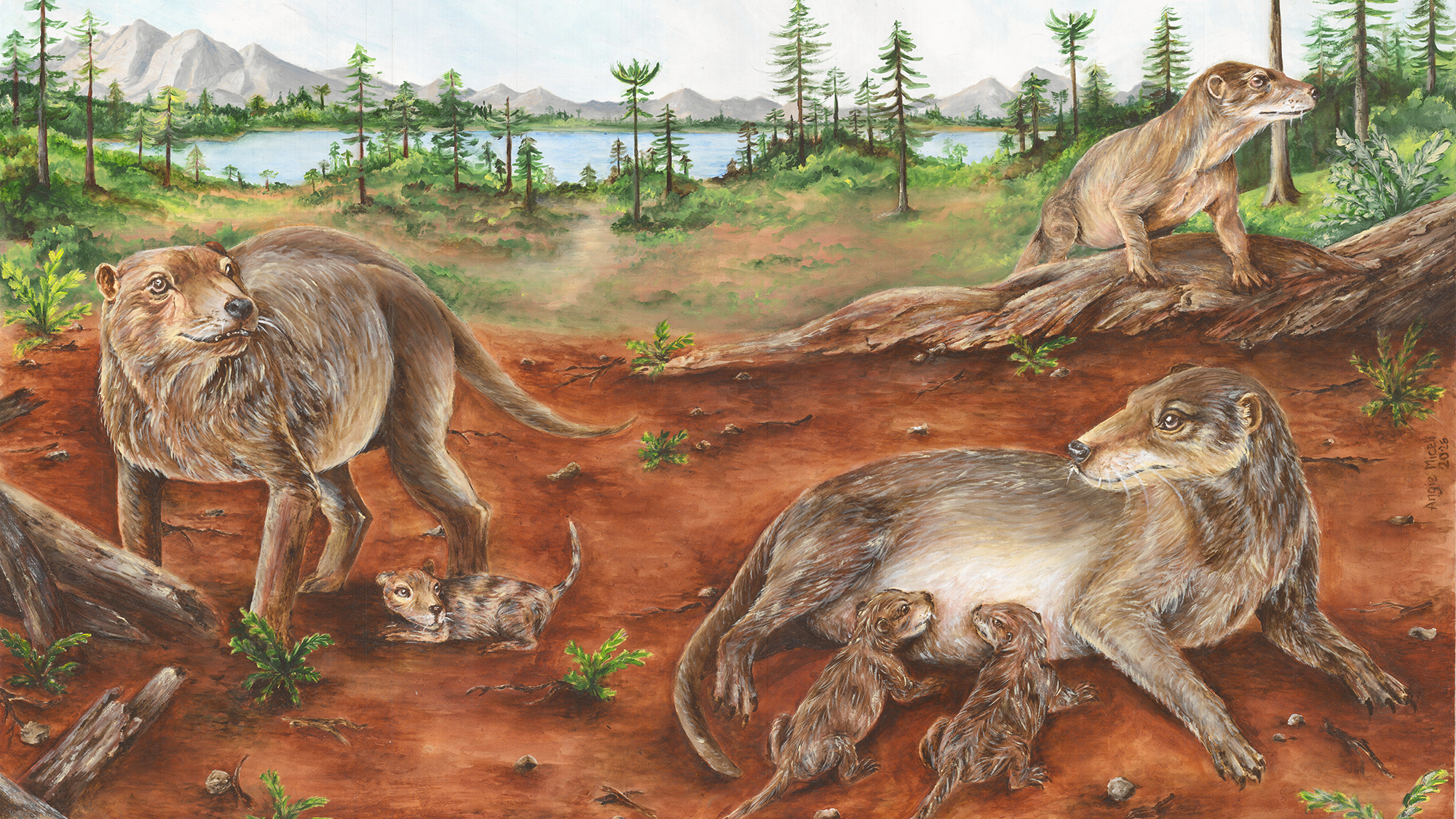
Researchers have discovered evidence suggesting that mammalian ancestors reproduced through live birth far earlier than previously believed. A fossilized bone from a dog-sized carnivore called Chiniquodon theotonicus, which inhabited what is now Argentina approximately 236 million years ago, contains a distinctive growth mark indicating the animal gave birth to living young rather than laying eggs. This finding pushes back the emergence of viviparity in the mammalian lineage by roughly 90 to 95 million years compared to earlier scientific estimates.
Scientists identified the growth mark as a neonatal line—a specialized bone structure that forms when growth rapidly accelerates following birth or hatching. By analyzing the fossilized remains and comparing birth-to-adult mass ratios across modern mammal, reptile, and bird species, researchers determined that the ancient cynodont’s reproductive pattern closely matched that of modern mammals rather than egg-laying species. The young animal weighed approximately 3.7 pounds at birth, about 14 percent of its 26-pound adult mass, a proportion far more consistent with live-bearing mammals than reptiles or birds.
Live birth may have offered significant survival advantages during the Triassic period, a challenging era marked by intense competition and predation following a massive extinction event. Young animals born alive could move away from threats, unlike eggs left vulnerable in nests. This research challenges long-held assumptions about when mammalian characteristics first appeared and suggests that modern mammal traits developed earlier in evolutionary history than scientists previously thought.
Originally reported by Livescience →
About the Author