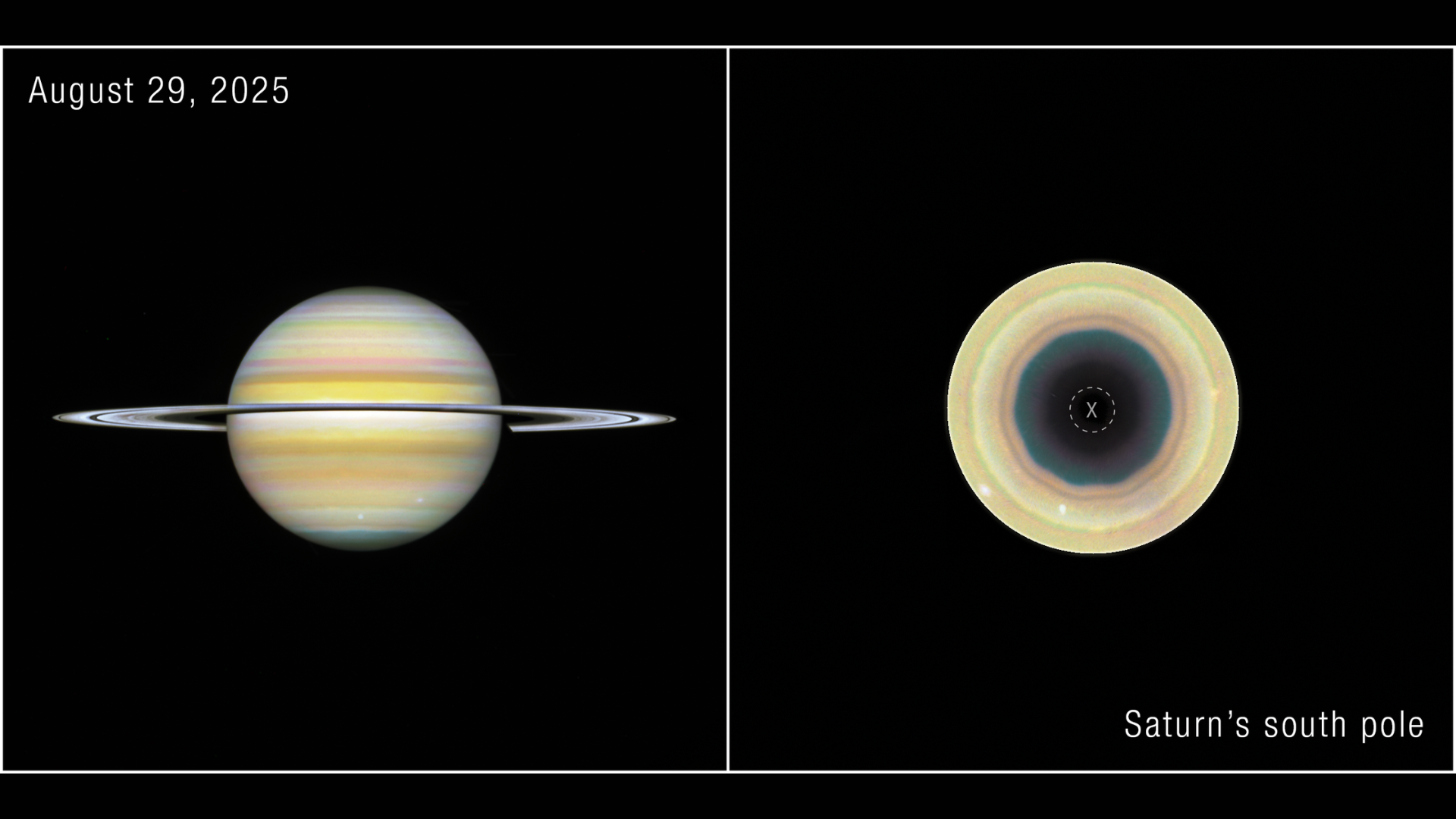
The Hubble Space Telescope has captured detailed images of a striking 10-sided atmospheric formation encircling Saturn’s south pole, marking a rare celestial phenomenon. Unlike the planet’s famous hexagonal feature at the north pole, which has persisted for over four decades, this newly observed decagon appears to have emerged recently around 2023, according to archival imagery. Scientists remain puzzled about the formation’s sudden appearance and its rapid development.
The atmospheric wave extends through multiple layers of Saturn’s atmosphere, reaching into its jet stream system. Researchers are eager to understand how this geometric pattern formed so quickly and what it reveals about weather dynamics on gas giants. NASA’s Amy Simon, a senior scientist at Goddard Space Flight Center, noted that this feature’s strengthening appearance presents an exceptional opportunity to observe the development of such a massive atmospheric structure in real time—something rarely witnessed in planetary science.
The discovery was initially made by ground-based observatories, with amateur astronomers and researchers from the University of the Basque Country contributing to the identification. High-resolution Hubble observations have since confirmed and clarified the decagonal structure. Saturn’s orbital position relative to Earth currently provides an optimal viewing angle for monitoring the south pole’s evolving patterns. Both the Hubble and James Webb Space Telescopes are expected to conduct additional observations, potentially unlocking secrets about how such dramatic atmospheric formations develop on distant worlds.
Originally reported by Livescience →
About the Author