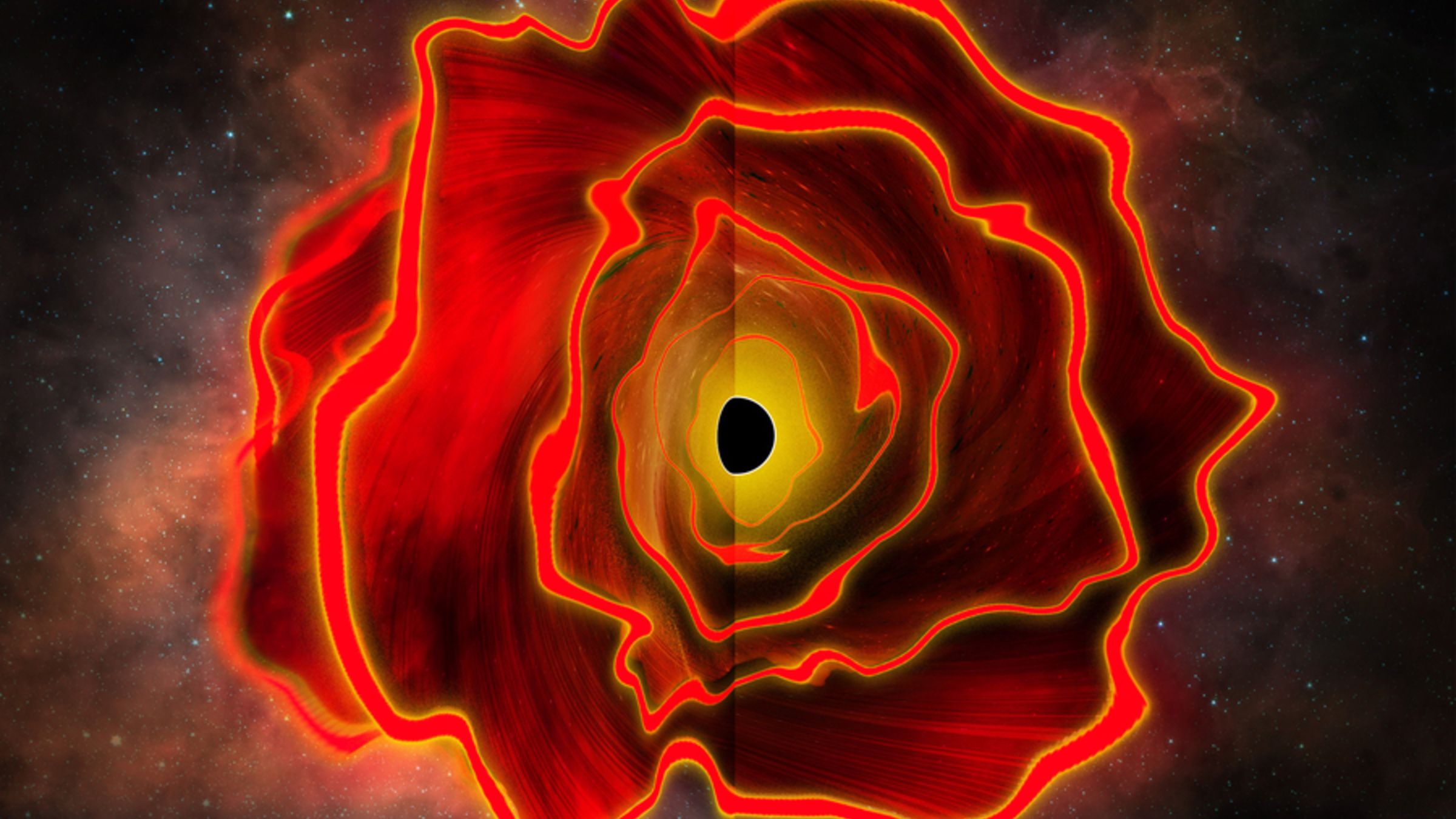
Astronomers using the James Webb Space Telescope have identified what may be the strongest evidence yet of a “black hole star,” a previously theoretical cosmic object discovered in the ancient universe. The discovery, made through the Miracle or Mirage survey and published in Nature, centers on an object called MoM-BH*-1 that formed just 660 million years after the Big Bang.
The object, roughly the size of our solar system, exhibits unusual characteristics that puzzled researchers. Its deep red coloration and distinctive light patterns suggested it was not an ordinary star or galaxy. Analysis revealed a complete absence of certain light wavelengths and minimal heavy metals, indicating the object is composed almost entirely of hydrogen and helium surrounding an extraordinarily dense core. Computer simulations suggested the only explanation was a supermassive black hole weighing up to 100,000 solar masses, wrapped in a superheated envelope of gas rather than the typical accretion disk.
This discovery may finally explain the “little red dots,” hundreds of mysterious, extremely distant objects detected by the telescope that shine brighter than individual stars but dimmer than full galaxies. Black hole stars could account for these puzzling objects by shielding the high-energy radiation normally emitted by similar systems, effectively disguising their true nature. Researchers propose that most of these cosmic dots may actually be mini-galaxies with black hole stars at their centers, formed when such objects collided with primordial star clusters in the universe’s infancy.
Originally reported by Livescience →
About the Author