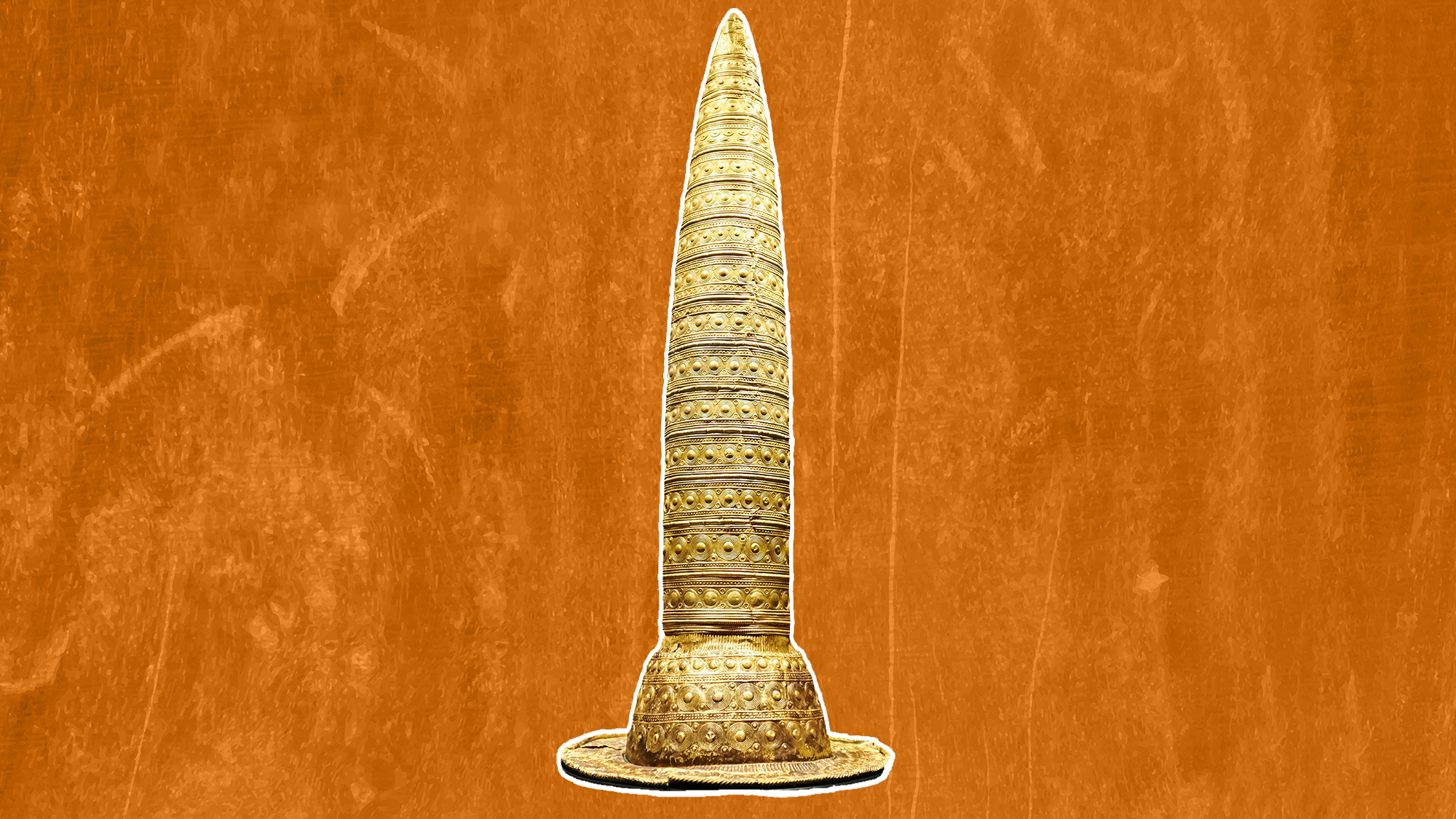
Archaeologists have identified a remarkable Bronze Age artifact that provides insight into ancient celestial knowledge and religious practices. The Berlin gold hat, a tall conical headpiece crafted from a single sheet of hammered gold approximately 3,000 years ago, is believed to have been worn by a priest during sun worship ceremonies. The artifact, which stands roughly 29 inches tall and weighs just over a pound, is currently housed in Berlin’s Museum of Prehistory and Early History.
Only four gold hats of this type from the Bronze Age have been discovered in Central and Western Europe, making the Berlin example particularly significant. While the exact location where this specific hat was found remains unknown due to its circulation through the antiquities market before acquisition in 1996, the other three similar artifacts were unearthed in southern Germany and western France, suggesting a probable origin in southern Germany for the Berlin piece.
The hat’s most intriguing feature lies in its decorative bands, which scholars believe encode astronomical information. According to research, the concentric circles, disks, and ovals adorning the artifact represent numerical values that form a functional calendar system. This calendar could track lunar months, solar years, and even predict lunar eclipses. Museum director Matthias Wemhoff has theorized that the hat’s wearer possessed specialized knowledge and may have worn the glittering gold headdress during mountaintop sunrise ceremonies, where its reflective surface would have captured the sun’s morning rays.
While no documented records confirm the existence of a Bronze Age European sun cult, other significant artifacts such as the Trundholm Sun Chariot and the Nebra Sky Disk suggest that ancient societies placed considerable importance on celestial bodies and astronomical phenomena.
Originally reported by Livescience →
About the Author