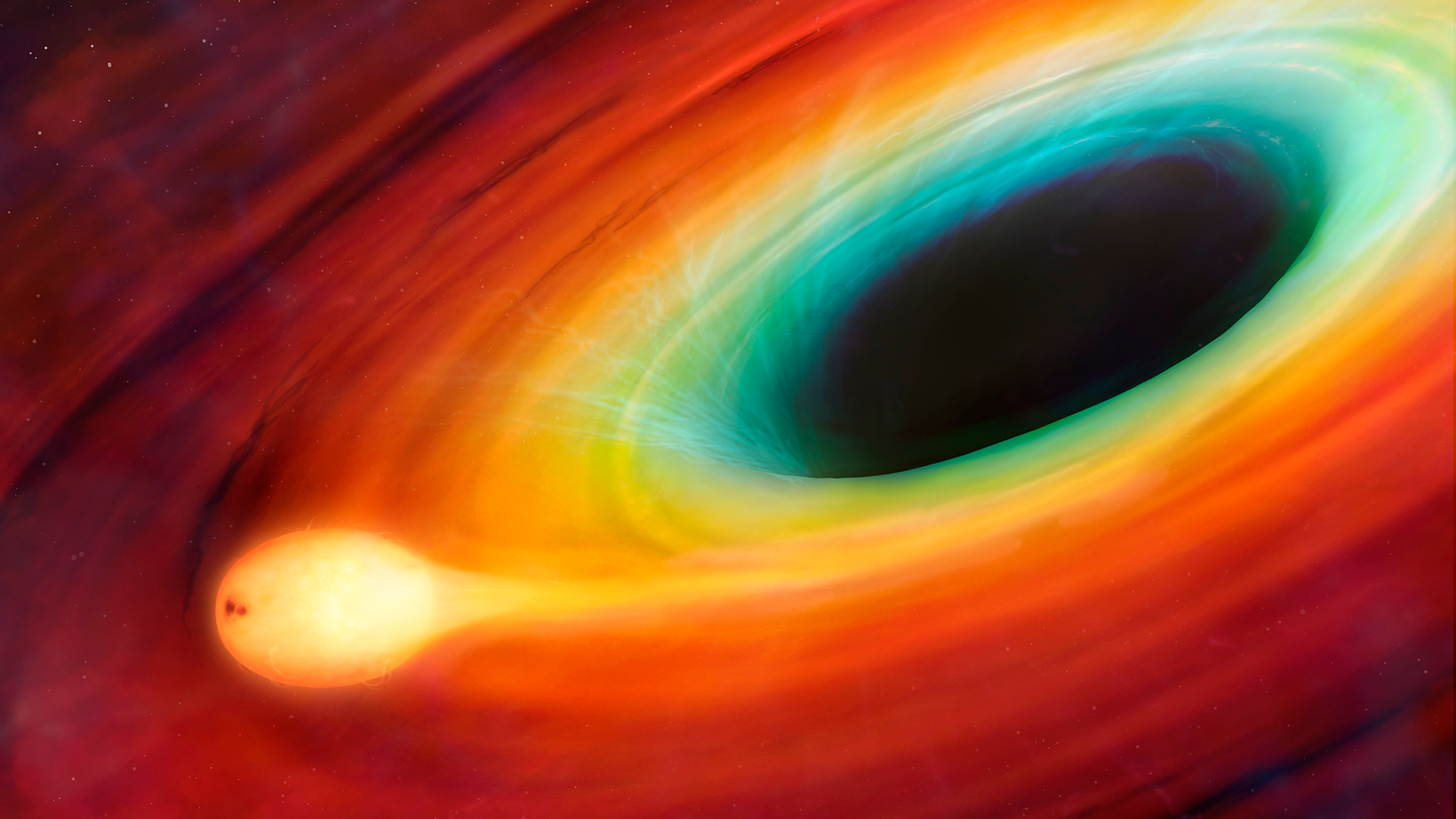
Researchers have identified an extraordinary celestial object orbiting the supermassive black hole at our galaxy’s center. The star, designated S301, represents a record-breaking discovery in terms of both its proximity and velocity relative to Sagittarius A*, the 4.3 million-solar-mass black hole located approximately 27,000 light-years away. The star completes one full orbit every 8.7 years while traveling at roughly 55 million mph, or about 8% of light speed. Scientists anticipate that observations over the next decade will enable them to measure the black hole’s rotation rate for the first time.
The discovery, announced in August in the journal Nature, was made possible by the GRAVITY instrument on the European Southern Observatory’s Very Large Telescope in Chile. Detecting S301 presented an extraordinary observational challenge, as the star is approximately 2 billion times fainter than Betelgeuse, one of the brightest stars visible from Earth. A new image-reconstruction technique combined with recent sensitivity upgrades to the instrument made this detection feasible. The star’s extremely tight, elongated orbit brings it within 12 astronomical units of the black hole—roughly ten times closer than S2, the previous record holder studied by astronomers since 1992.
S301’s extreme orbital characteristics hint at a dramatic past. Researchers propose that the star was once part of a binary system that ventured too close to the black hole. Gravitational forces tore the pair apart, flinging one component into space as a hypervelocity star while S301 remained captured in its current trajectory. Already, measurements reveal strong relativistic effects, with the orbital ellipse rotating approximately 2 degrees with each complete lap around the black hole, confirming predictions from Einstein’s theory of general relativity.
Originally reported by Livescience →
About the Author