
What The Heck Are We Looking at? This Week’s Monday Microscope Mystery
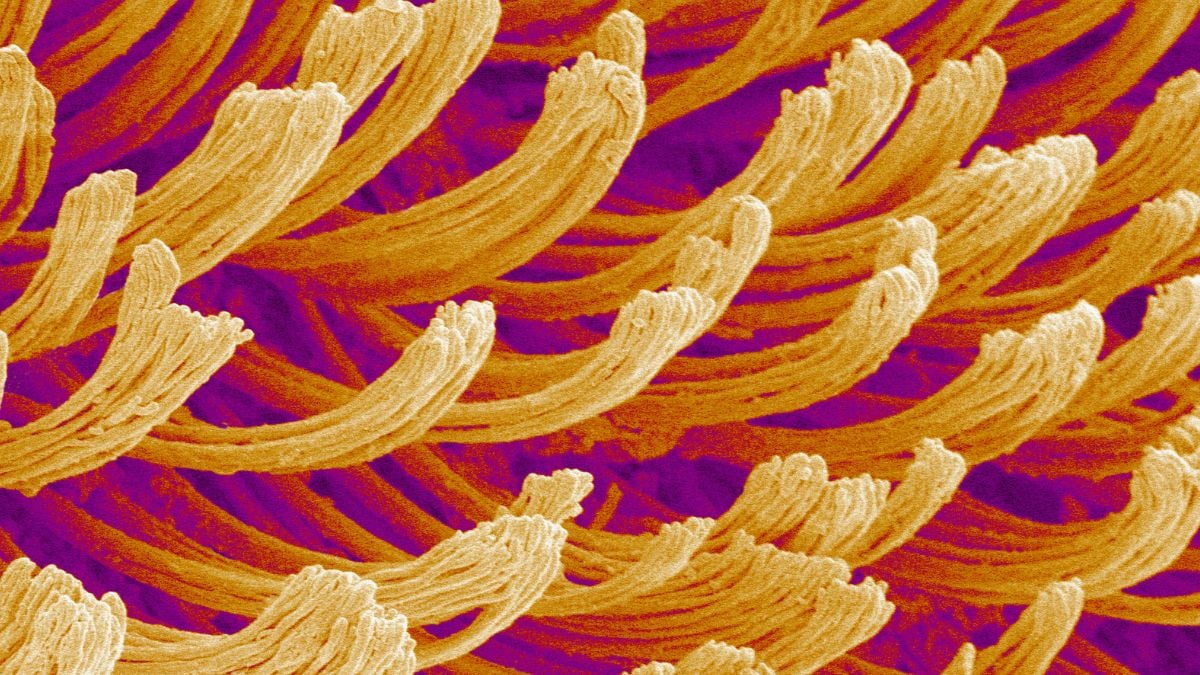 A '60s shag rug?
“`html
This week’s Microscope Mystery featured a densely packed structure resembling a forest canopy viewed from above. The image, captured through a scanning electron microscope, showcased countless branching filaments tightly clustered together with minimal gaps between them. Readers were invited to guess the origin of this intricate pattern before being presented with the answer.
The mystery subject turned out to be the underside of a gecko’s foot. The hair-like structures visible in the image are called setae, with each toe containing hundreds of thousands of them. What makes this discovery particularly fascinating is that each seta branches further into even tinier structures known as spatulae, creating an extraordinarily complex adhesive system.
Contrary to common assumptions, geckos do not rely on sticky substances, suction, or hooks to climb. Instead, their feet utilize van der Waals forces—weak intermolecular attractions that allow the spatulae to grip surfaces at the molecular level. Scientists have determined that if all of a gecko’s setae engaged simultaneously, the animal could theoretically support approximately 133 kilograms, far exceeding its actual body weight.
Equally remarkable is the gecko’s ability to release its grip rapidly while climbing. By peeling its toes at a specific angle, the contact area diminishes sharply, enabling the animal to unstick almost instantaneously. It’s worth noting that the colors visible in these microscope images are artificial additions designed to enhance visual clarity, as scanning electron microscopes produce images in grayscale.
“`
Originally reported by Sciencealert →
About the Author