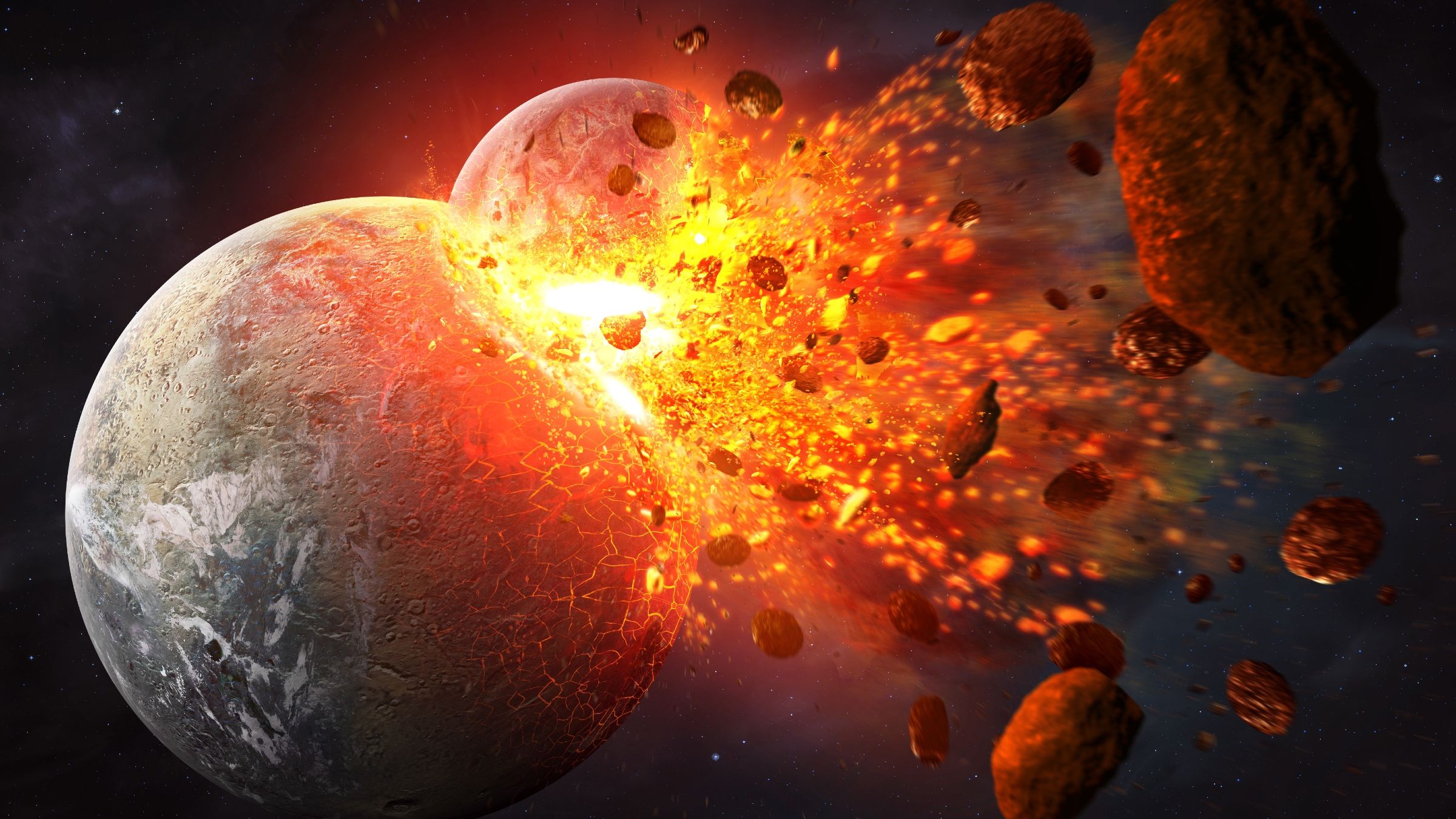
New computer modeling suggests that Earth’s moon could have formed remarkably quickly following a catastrophic collision between our planet and a Mars-sized celestial body called Theia. According to simulations published in The Astrophysical Journal Letters, the lunar formation process may have taken as little as five hours under certain conditions. This finding offers fresh insights into how our solar system’s most dramatic cosmic event unfolded billions of years ago.
Scientists have long believed the giant impact hypothesis explains the moon’s origins, with the collision occurring roughly 4.5 billion years ago when both celestial bodies were young and extremely hot. Previous research focused primarily on the masses of the colliding objects, but the latest study examined a previously overlooked factor: the material strength and hardness of Earth and Theia’s surfaces. Because both bodies were scorching at the time of impact, their soft or molten exteriors would have cushioned the collision, allowing debris to remain largely intact and enabling faster lunar assembly compared to earlier theoretical models.
These revised simulations carry implications beyond our moon’s history. The emphasis on material strength in planetary collision modeling could reshape understanding of other major impact events throughout the cosmos, including collisions that formed moons around Jupiter and Saturn. The research may also help astronomers searching for exomoons around distant planets, as debris fields from such impacts could dissipate much more quickly than previously assumed.
Originally reported by Livescience →
About the Author