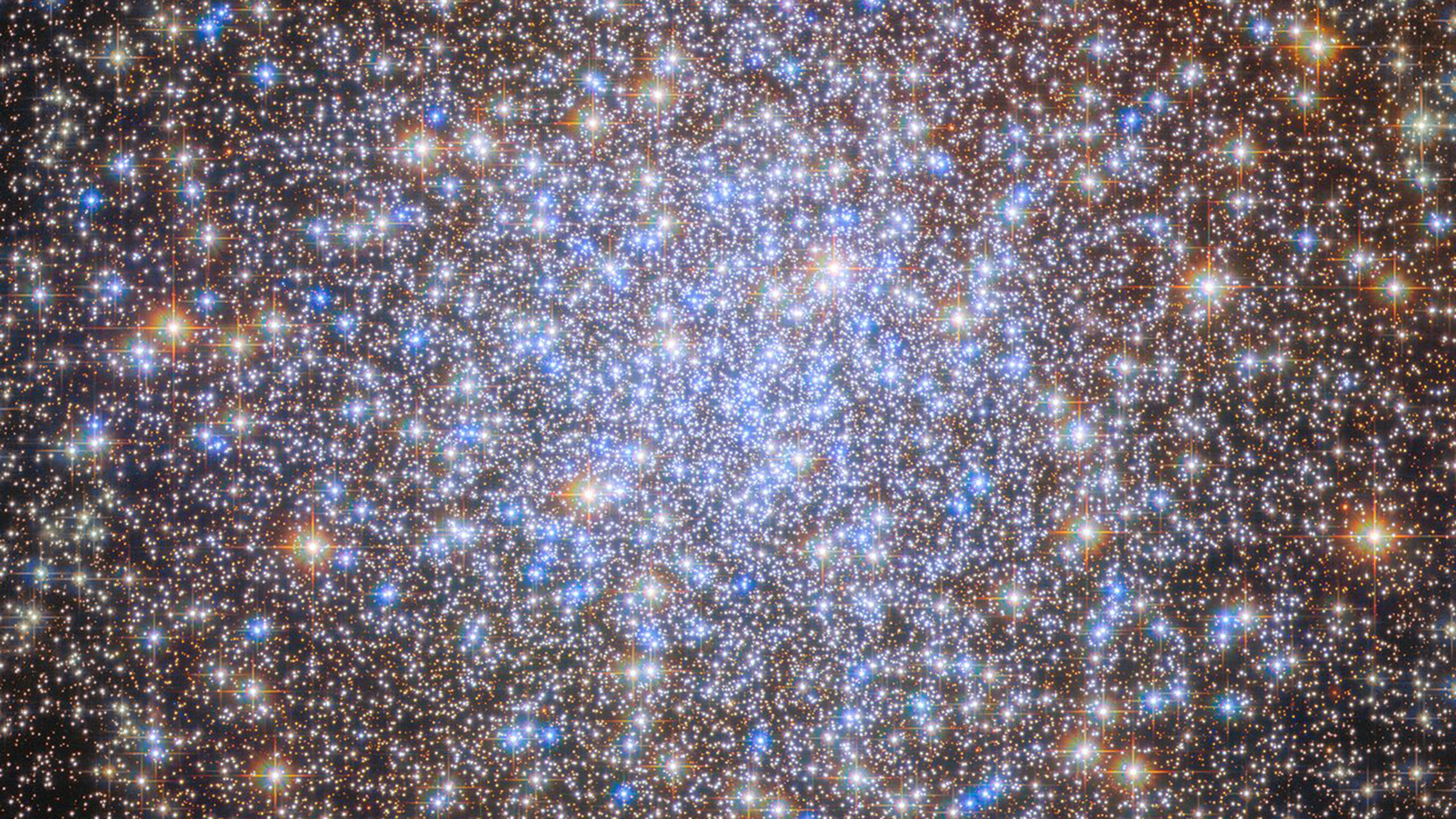
The Hubble Space Telescope has captured a striking image of NGC 6723, a globular cluster situated approximately 27,000 light-years away in the constellation Sagittarius. The celestial object, nicknamed the Chandelier Cluster, contains millions of stars bound together by gravitational forces, creating one of the most visually spectacular structures orbiting the Milky Way’s outer regions.
Globular clusters represent some of the oldest known formations in our galaxy, with many stars within them exceeding 10 billion years in age. Scientists have long puzzled over the stellar populations within these ancient structures, particularly regarding their origins and development. The Hubble observations of NGC 6723 reveal an unexpected complexity that challenges previous assumptions about how these clusters form and evolve.
Contrary to earlier theories suggesting all stars within a globular cluster originated simultaneously from identical materials, Hubble’s detailed imaging demonstrates significant variations. The cluster’s center displays concentrations of younger blue stars, while older orange stars predominate toward the outer edges. This distribution indicates that NGC 6723 experienced at least two distinct periods of star formation, separated by approximately 634 million years, revealing that globular clusters possess more intricate histories than previously understood.
Researchers theorize that globular clusters may have originated from collapsing gas clouds in the early universe, though recent simulations propose an alternative explanation: some clusters could represent the surviving cores of ancient dwarf galaxies consumed by larger ones. These ancient structures serve as valuable windows into galactic evolution and development across the cosmos.
Originally reported by Livescience →
About the Author