
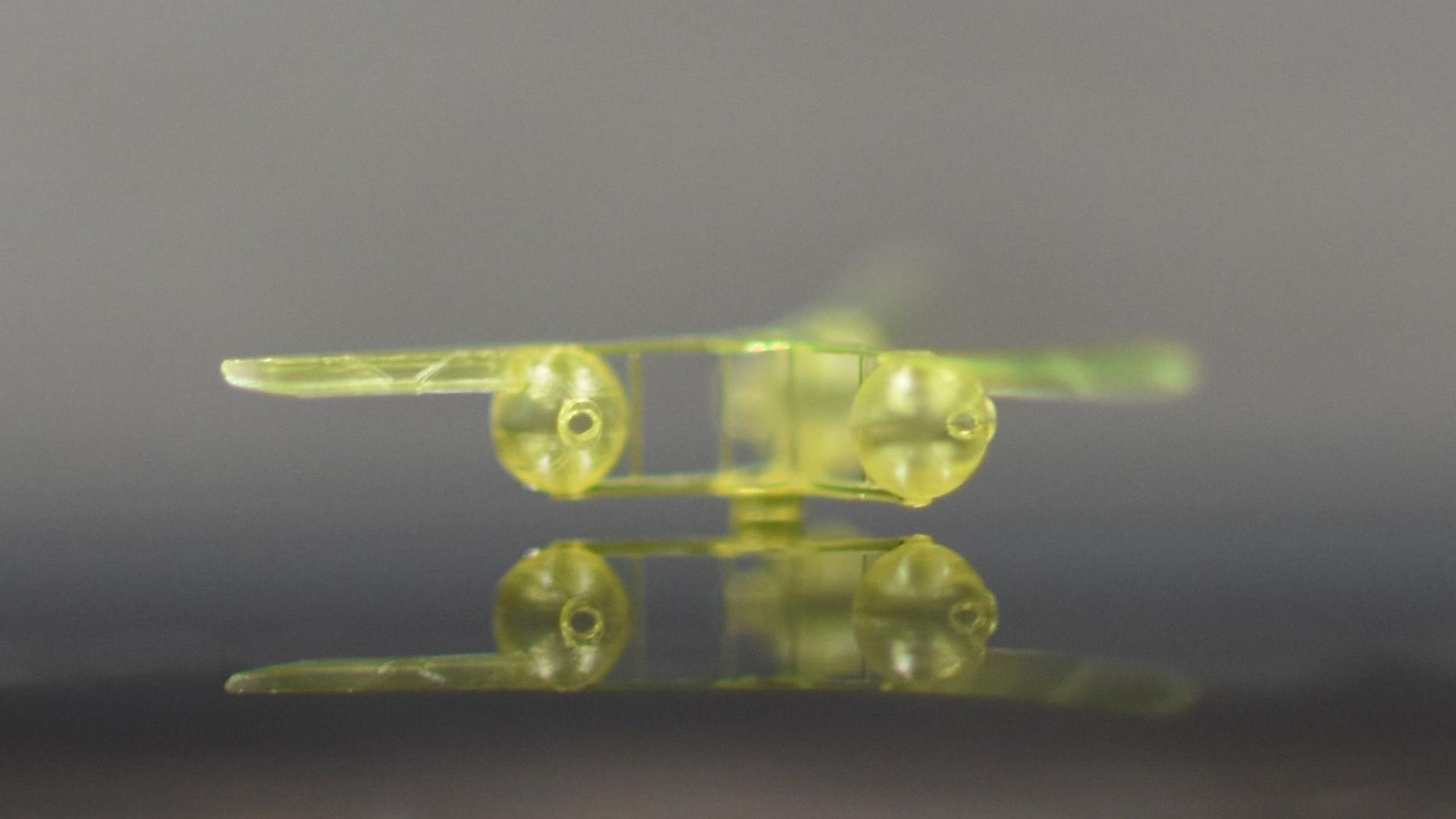
Engineers at the Swiss Federal Technology Institute of Lausanne have developed miniature robots that operate without traditional motors, instead utilizing sound waves as their sole power source. The innovation was detailed in a study published in Science Advances in August, marking a significant breakthrough in robotics technology.
The devices function through a principle called Helmholtz resonance, a phenomenon first documented in 1856 by German physicist Hermann von Helmholtz. When sound at the correct frequency strikes hollow chambers built into the robots’ structure, the air inside resonates and generates a jet of air powerful enough to propel small watercraft or lift tiny flying mechanisms off the ground. By miniaturizing these resonators, researchers were able to operate them at ultrasonic frequencies inaudible to human ears, allowing for precise control without the noise concerns associated with audible sound.
The team constructed two types of devices using advanced three-dimensional printing techniques. Larger versions included boats approximately five centimeters long equipped with directional resonators that enabled steering by adjusting sound frequencies. Smaller variants, some measuring just one millimeter across, functioned as microfliers that either generated downward thrust similar to rockets or rotated attached blades like helicopters.
According to researchers, this approach offers distinct advantages over conventional motors, which face inherent miniaturization limits due to required physical components. Since resonators consist merely of precisely shaped hollow spaces, they could theoretically be scaled down indefinitely, opening possibilities for applications in object manipulation and biomedical devices.
Originally reported by Livescience →
About the Author