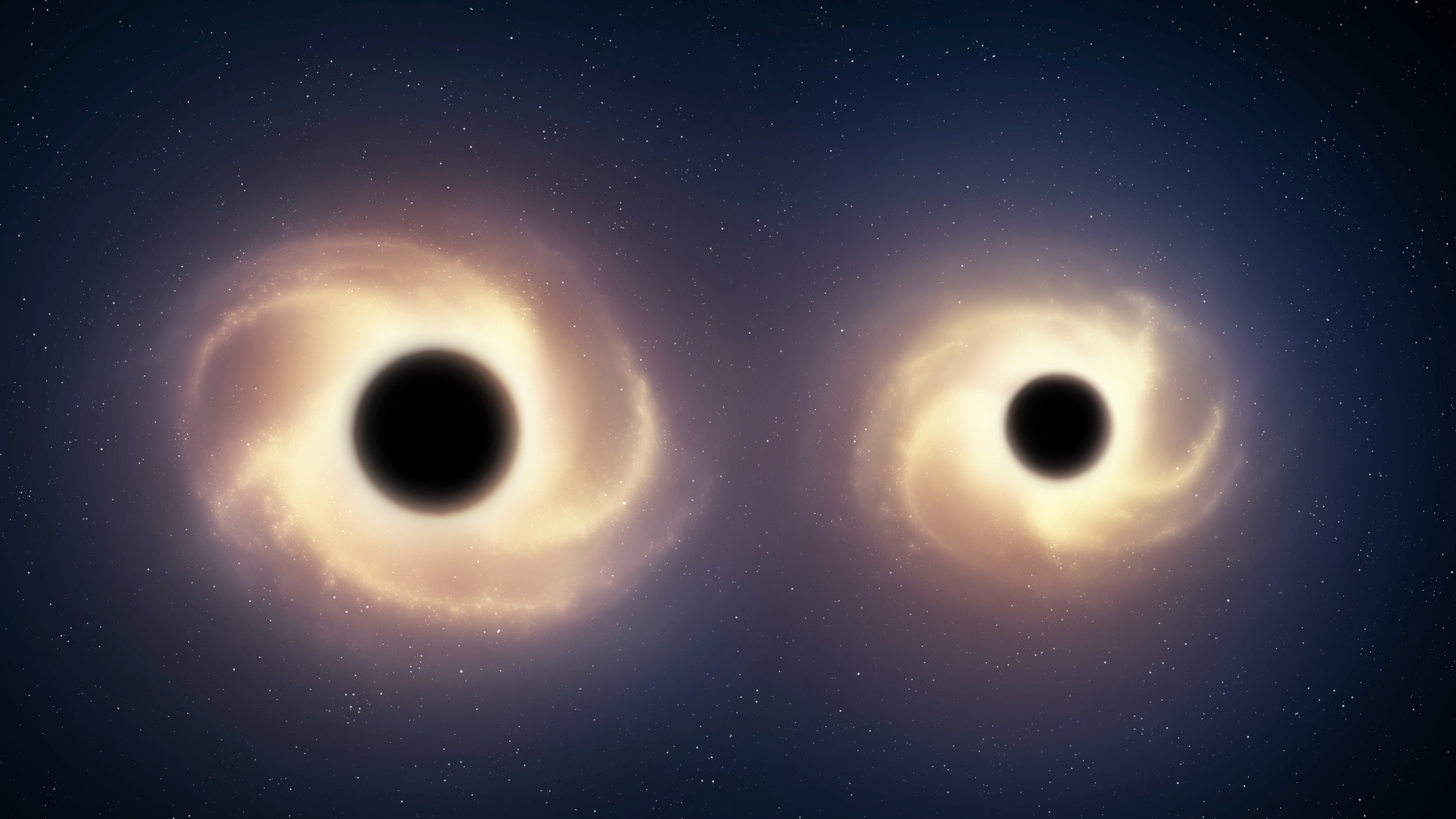
Astronomers using the James Webb Space Telescope have identified what appears to be the earliest and most closely positioned pair of feeding supermassive black holes ever detected. The system, designated LID-1166, existed when the universe was merely 1.3 billion years old and features two black holes separated by roughly 4,900 light-years within a galaxy undergoing a merger. This discovery provides unprecedented insight into a crucial phase of supermassive black hole development in the cosmos’s earliest epochs.
Researchers led by astronomer Hyewon Suh initially spotted LID-1166 through X-ray observations, but the object remained invisible in deep Hubble imagery. Using the James Webb Space Telescope’s Near-Infrared Spectograph instrument alongside radio telescope data from Chile, scientists revealed two compact luminous sources previously hidden by surrounding dust and gas. While other potential dual black hole systems have been detected at earlier cosmic times, those pairs were separated by vastly greater distances, making LID-1166 the first confirmed case of two black holes existing this proximity in the early universe.
Both objects displayed spectral characteristics indicating active black holes rapidly consuming material from their surroundings. Additional observations revealed substantial cold gas surrounding each black hole, suggesting they reside within distinct galaxies currently merging. This discovery may help explain a significant astronomical puzzle: how certain supermassive black holes achieved remarkable growth rates during the universe’s infancy. The research has been accepted for publication in the journal Nature Astronomy.
Originally reported by Livescience →
About the Author