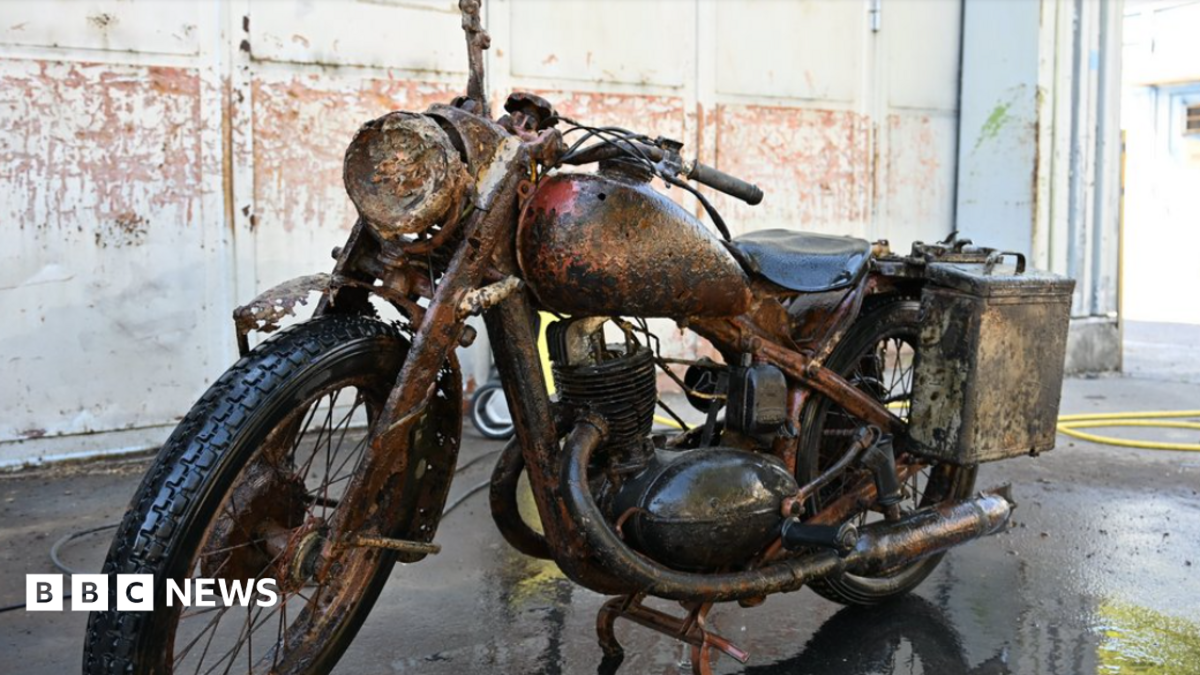
An exceptional discovery in Budapest’s Danube River has brought renewed hope to families seeking answers about their World War Two ancestors. The remains of two German soldiers surfaced in early August due to historically low water levels caused by drought conditions across Europe. The find also included a largely preserved Wehrmacht motorcycle, identification tags belonging to both soldiers, a wedding ring, and a Kuban combat badge.
The artifacts emerged on the riverbank in downtown Budapest when a passerby noticed part of the motorcycle protruding from rocks. Authorities temporarily closed the area after anti-tank mines were discovered nearby. The German War Graves Commission attributes the remarkable preservation of items to the unique composition of the riverbed, which contains harbor sludge and oil that protected the objects from deterioration over more than eight decades.
Investigators face a complex process in identifying the soldiers. While the identification tags may quickly reveal names, officials emphasize that additional evidence, including bone analysis, will be necessary to confirm identities. The commission noted that families of these soldiers likely never received official notification of their deaths, as one identification tag belonged to a Wehrmacht soldier and the other to a Waffen-SS member. The soldiers are scheduled to be laid to rest at a German war cemetery near the Hungarian capital.
This discovery represents one of several World War Two artifacts recently exposed by the Danube’s dramatically reduced water levels, offering potential closure to descendents still searching for information about missing relatives from the conflict.
About the Author