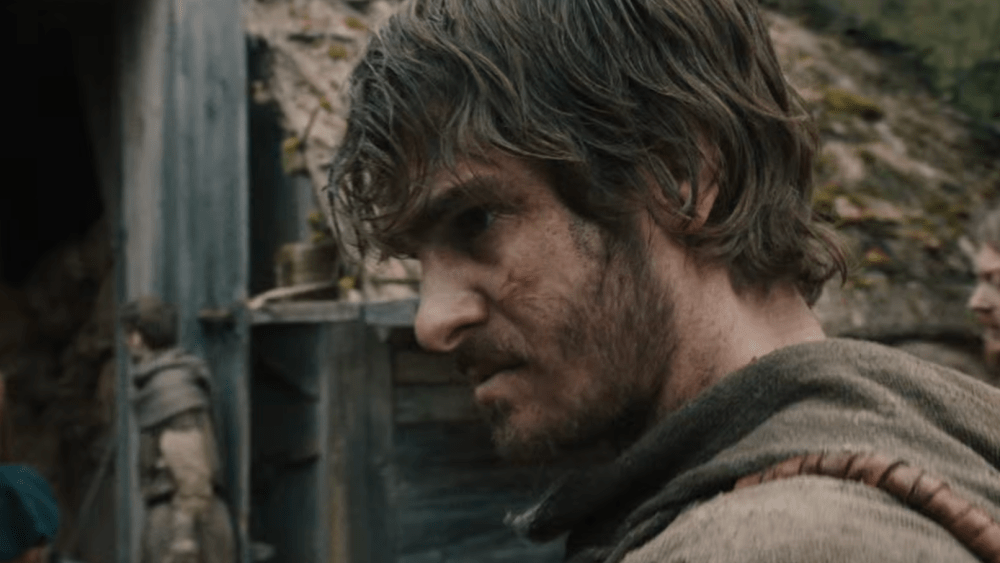
Director Paul Greengrass brings his signature documentary-style approach to “The Uprising,” a historical drama centered on the 1381 Peasants’ Revolt in medieval England. Andrew Garfield stars as the Ploughman, a grieving farmer whose family perished during the plague that devastated the country. Driven by desperation and injustice, Garfield’s character becomes an unlikely leader in a rebellion against an oppressive ruling class that has imposed crushing new taxes on the common people.
The film follows dual narratives, contrasting the Ploughman’s rise to prominence with the political machinations surrounding the young King Richard II, portrayed by Woody Norman. Supporting performances from Katherine Waterston, Tom Hollander, and Jamie Bell as the revolutionary priest John Ball provide depth to the court intrigue and rebel movement. Garfield and fellow rebel Thomasin McKenzie share particularly compelling scenes that capture the passion of the uprising.
Greengrass applies his characteristic shaky-camera cinematography and chaotic visual style to the 14th-century setting, a choice that remains divisive among viewers. While the director’s documentary-influenced techniques have earned acclaim in previous works like “Bloody Sunday” and “United 93,” they prove less cohesive here. The film’s mixture of intimate character drama and sprawling historical scope creates uneven results, though earnest performances and ambitious storytelling provide compensations for its structural shortcomings.
Originally reported by Variety →
About the Author