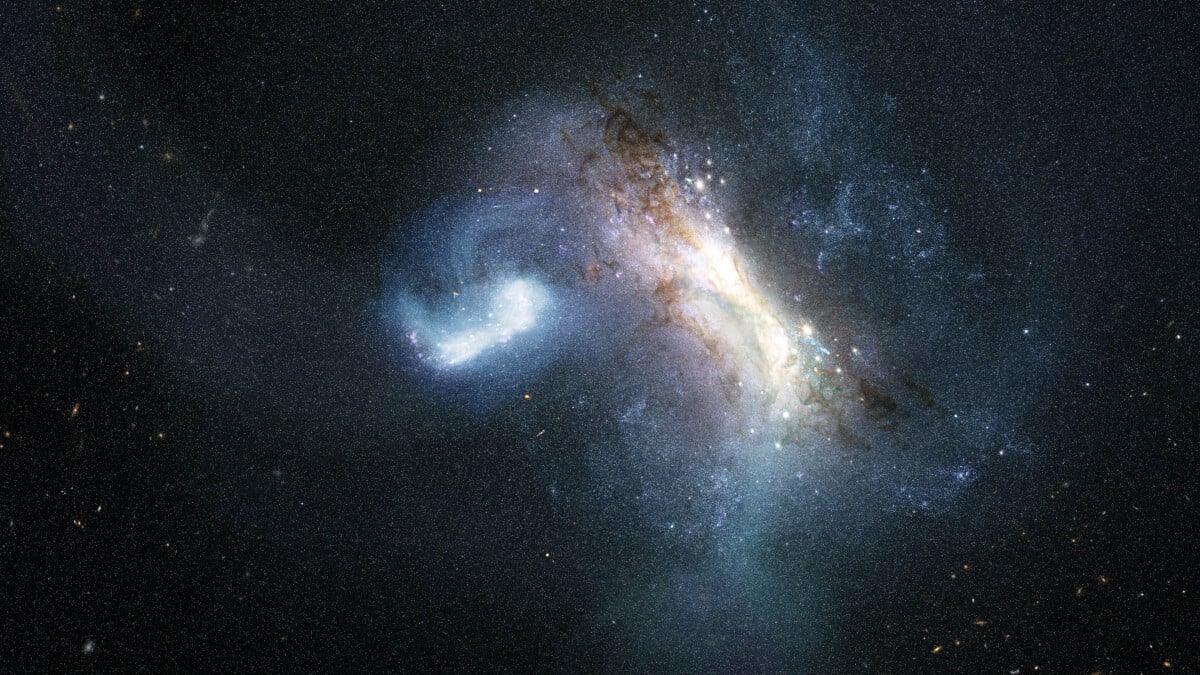
Astronomers have identified remnants of an ancient galaxy that merged with the Milky Way approximately 12.3 billion years ago, buried within the chaotic stellar environment at the galactic center. This discovery, published in Nature Astronomy, reveals previously unknown details about how our galaxy assembled itself over billions of years through collisions with smaller dwarf galaxies. The findings demonstrate that researchers can trace the Milky Way’s violent past by analyzing the ages and chemical composition of star clusters.
Scientists used NASA’s Hubble Space Telescope to examine 39 globular clusters—dense groupings of ancient stars—located in the galactic core. By comparing the clusters’ ages, chemical properties, and orbital patterns, researchers identified three distinct stellar populations. The newly discovered galaxy, designated Low-energy-Kraken-Heracles or LKH, collided with the Milky Way approximately 1.8 billion years before a previously known merger event with the massive Gaia-Sausage-Enceladus system roughly 10 billion years ago.
The LKH galaxy, weighing about 500 million times the mass of Earth’s sun, deposited most of its stellar material deep within the inner 20,000 light-years of the Milky Way’s disk. This discovery challenges earlier theories suggesting that the galaxy’s oldest stars originated within the Milky Way itself, proving instead that external galaxies contributed significantly to the formation of the galactic center. Computer simulations corroborated the team’s findings, validating their timeline and chemical analysis.
Originally reported by Mashable →
About the Author