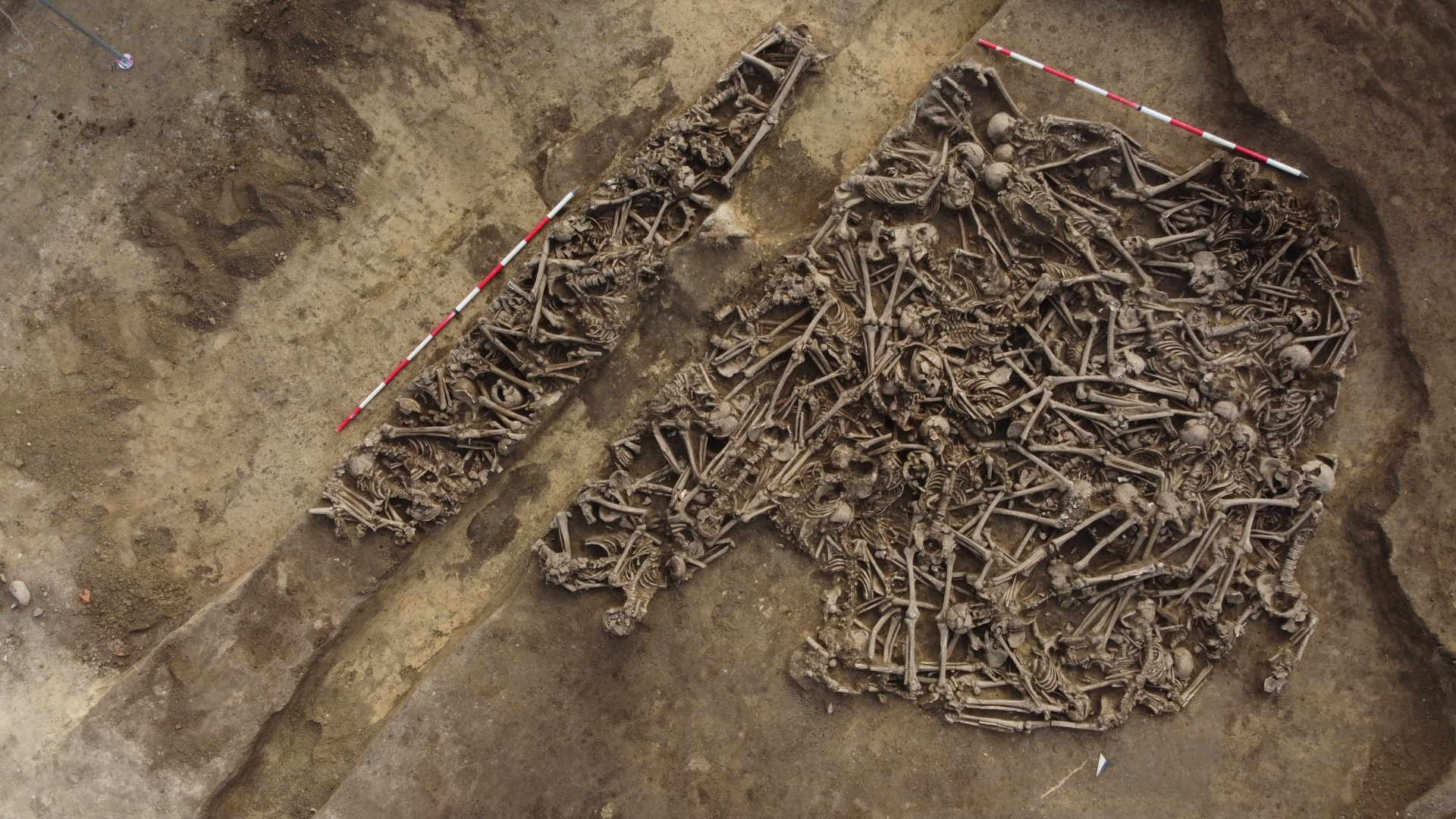
Archaeologists in Austria have uncovered a significant mass grave beneath a soccer field in Vienna that may represent casualties from an undocumented ancient Roman conflict. Excavated in 2024, the burial site contains approximately 129 skeletons dating to the first and second centuries A.D., all believed to be young male soldiers from across the Roman Empire. The remains were interred in a chaotic, disorganized manner with minimal grave goods, though a few weapons were discovered among the bones.
Analysis of the skeletons reveals extensive evidence of violent trauma sustained around the time of death, with over two-thirds of the individuals bearing injury marks. Researchers identified sharp wounds consistent with swords and daggers distributed across the bodies, blunt force trauma concentrated on skulls, and notably, projectile injuries focused on the groin area. In one case, a lance head remained embedded within a skeleton’s pelvis, suggesting attackers deliberately targeted vulnerable areas of the body lacking protective armor.
Located in the Hasenleitengasse neighborhood near Vienna’s ancient Roman settlement of Vindobona, the site presents an archaeological puzzle. Despite the clear military nature of the remains and the strategic importance of Vindobona as a Roman outpost defending against Germanic tribes, no historical records reference a battle at this location. Preliminary DNA analysis of selected remains indicates diverse ancestry among the deceased, with individuals originating from Italy, mainland Europe, and the eastern Mediterranean, suggesting the possibility of a mixed force or a commingled burial of Romans and opposing combatants.
Originally reported by Livescience →
About the Author