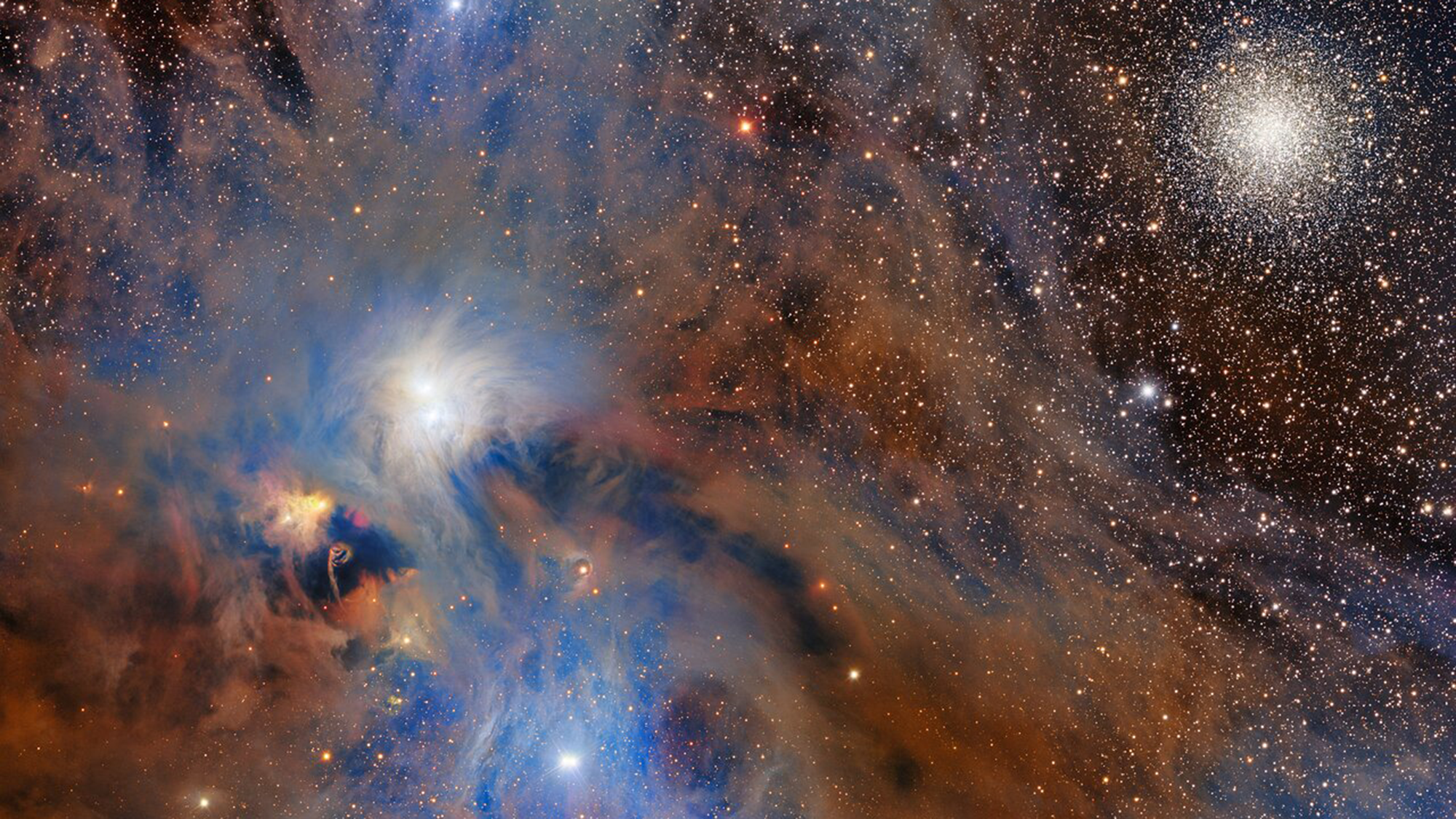
A striking new astronomical image released in July 2026 showcases the Corona Australis Molecular Cloud, a nearby star-forming region located 430 light-years away. The photograph, captured by the Dark Energy Camera mounted on the Victor M. Blanco 4-meter Telescope in Chile, evokes the swirling patterns characteristic of Vincent van Gogh’s famous paintings. The advanced instrument, equipped with 74 detectors and a one-meter-wide lens, reveals intricate details of nebulae, dust lanes, and stellar clusters across its expansive field of view.
The Corona Australis Molecular Cloud represents one of the solar system’s closest active star-formation regions, where temperatures plummet to approximately minus 440 degrees Fahrenheit. Under these extreme conditions, dense concentrations of gas and dust collapse to give birth to new stars. The image captures NGC 6729, a glowing nebula featuring both blue reflection nebulae and orange emission nebulae, alongside the binary star system R Coronae Australis at its core.
The photograph also includes NGC 6723, a globular cluster positioned nearly 30,000 light-years away. This ancient star cluster, containing hundreds of thousands of stars, harbors some of the universe’s oldest celestial bodies. Astronomers believe multiple stellar populations exist within the cluster, suggesting a complex cosmic history. Both featured objects remain popular observation targets due to their relative proximity, though they are optimally visible from the Southern Hemisphere.
Originally reported by Livescience →
About the Author