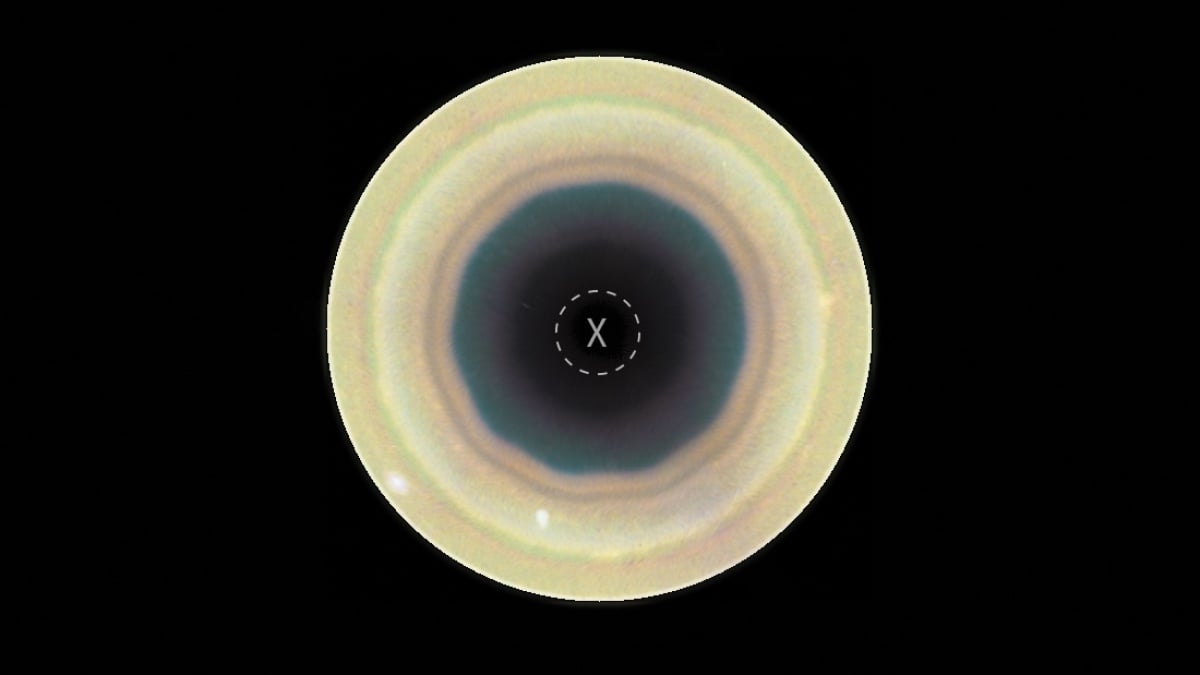
Astronomers using NASA’s Hubble Space Telescope have identified a massive 10-sided atmospheric wave pattern encircling Saturn’s southern pole. The structure, called a decagon, forms part of a powerful jet stream that races across the planet’s mid-latitudes. Observations became possible only recently because Saturn’s axial tilt had previously kept the south pole turned away from Earth for more than a decade, preventing clear telescopic viewing of the region.
The decagon is not a solid cloud formation but rather a repeating atmospheric wave that circles the entire planet, with each side stretching approximately 10,000 miles. Wind speeds in the jet stream reach roughly 260 miles per hour, and the wave’s corners shift gradually over monthly cycles. Unlike Earth’s chaotic cloud patterns, disrupted by mountains and continents, Saturn’s gaseous atmosphere allows atmospheric waves to settle into regular geometric shapes without such obstacles.
The discovery presents scientists with an unusual opportunity to study how planetary winds organize themselves. Researchers noted that the pattern appears to have formed recently, as NASA’s Cassini spacecraft found no evidence of it during its 2004-2017 mission. Computer simulations suggest that strong jets nudged by nearby disturbances, such as a red storm located north of the decagon, can generate polygon-like waves. This finding connects to broader solar system mysteries, including Jupiter’s polar cyclone clusters and Saturn’s long-standing hexagonal north pole formation.
Originally reported by Mashable →
About the Author