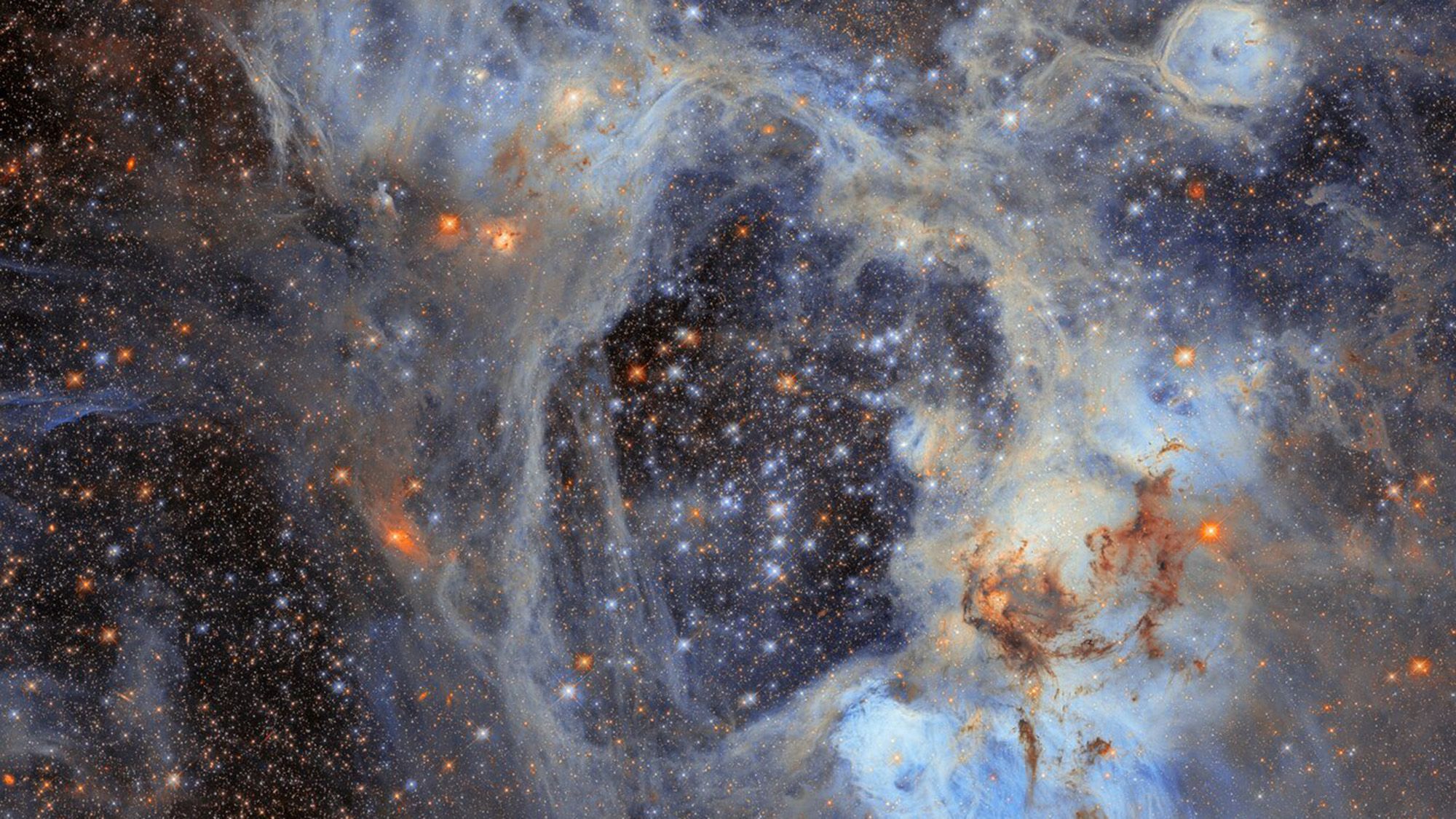
The Hubble Space Telescope has revealed a striking cosmic phenomenon in a nebula located 160,000 light-years away. Known as LHA 120-N44, this vast celestial structure exists within the Large Magellanic Cloud and appears in Earth’s sky within the constellation Dorado. The nebula’s distinctive hollow appearance, spanning approximately 210 by 140 light-years, earned it the designation “superbubble” due to its enormous cavity-like shape.
At the heart of this superbubble lies a cluster of massive, intensely hot stars that are responsible for creating the surrounding void. These stellar giants expel tremendous amounts of material through powerful stellar winds, similar to the solar wind generated by our own sun. The most massive among them eventually undergo catastrophic explosions as supernovas, further dispersing gas throughout the region. The combined radiation from these stellar events has carved out the nebula’s impressive hollow chamber.
Rather than simply destroying their surroundings, these massive stars inadvertently facilitate stellar creation elsewhere. The gas and dust ejected outward becomes compressed into dense shells around the superbubble’s perimeter. Within these compressed layers, conditions become favorable for new star formation to begin. This reciprocal process, termed “stellar feedback,” demonstrates how stellar destruction and creation operate as interconnected cosmic cycles.
The Hubble image contains nearly 500,000 stars, with approximately 30,000 identified as young stellar objects not yet mature enough to fuse hydrogen. This abundance of proto-stars offers astronomers a unique opportunity to study stellar development and address fundamental questions about how long the star formation process actually requires.
Originally reported by Livescience →
About the Author