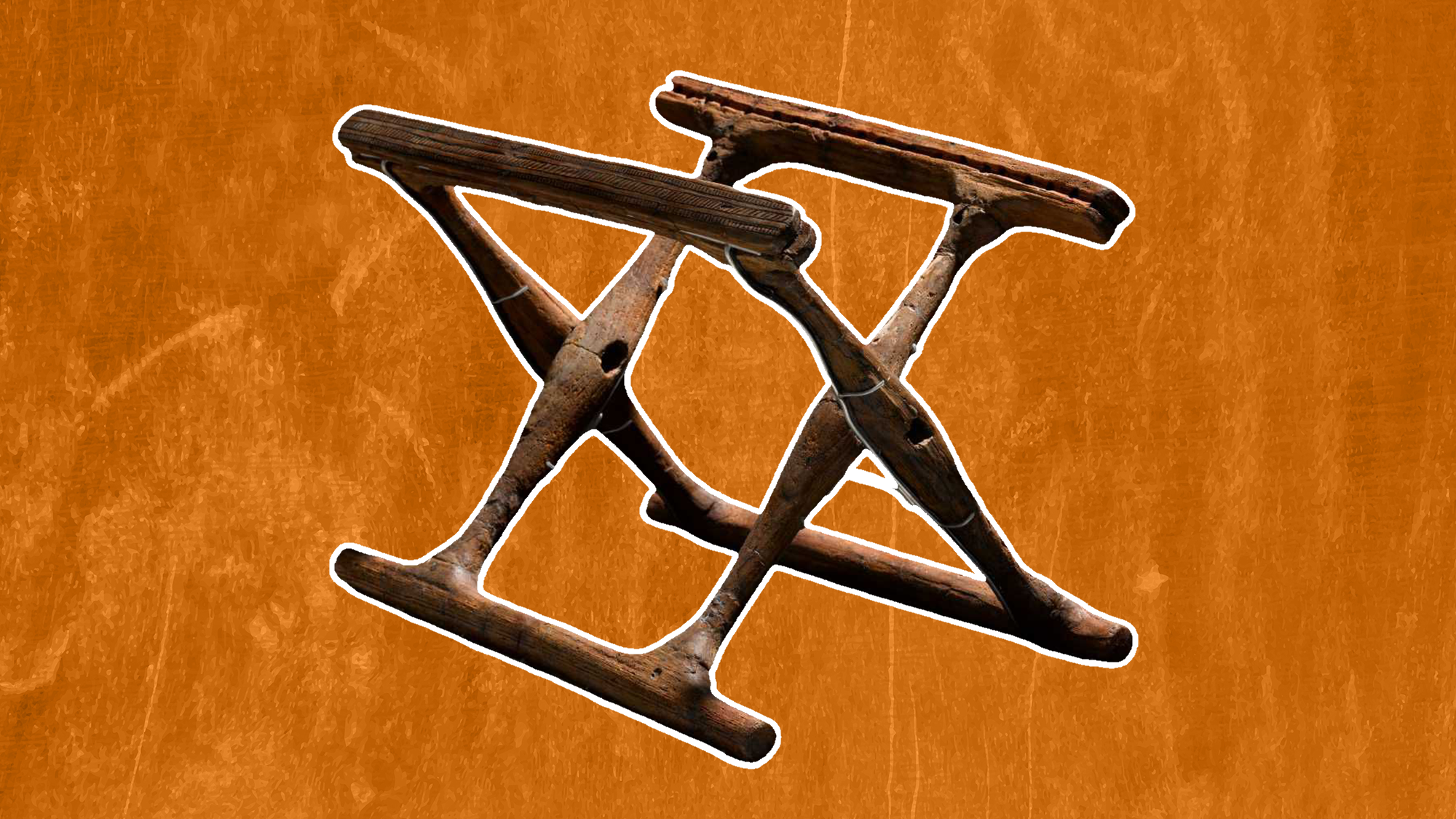
Danish archaeologists unearthed a remarkable Bronze Age artifact during an 1891 excavation at Guldhøj in southern Jutland: a wooden folding chair dating to approximately 1400 B.C. This discovery represents the only completely intact chair from the Bronze Age surviving in Europe, according to the National Museum of Denmark. The chair was found in the grave of a chieftain, alongside other prestigious items including bronze weapons, ornate wooden vessels, and fine clothing.
The folding chair’s construction reveals sophisticated craftsmanship, featuring an ash wood frame with a seat fashioned from otter skin. Geometric patterns were carved into the wooden frame and filled with a dark tar-like substance for decoration. The two-part frame, each section standing approximately 13 inches tall, could be angled at 45 degrees to create a seat roughly 9.5 inches from the ground. Bronze nails likely held the original structure together before being removed prior to burial.
The chair’s presence in a chieftain’s grave underscores its significance as a status symbol. Researchers have identified similar folding chair designs in ancient Egypt and Greece, suggesting Bronze Age societies exchanged cultural ideas through trade and diplomacy. Fragments of comparable chairs have been found in other elite graves across Denmark and northern Germany, yet the Guldhøj example remains uniquely complete, offering invaluable insights into prehistoric European furniture and social hierarchies.
Originally reported by Livescience →
About the Author