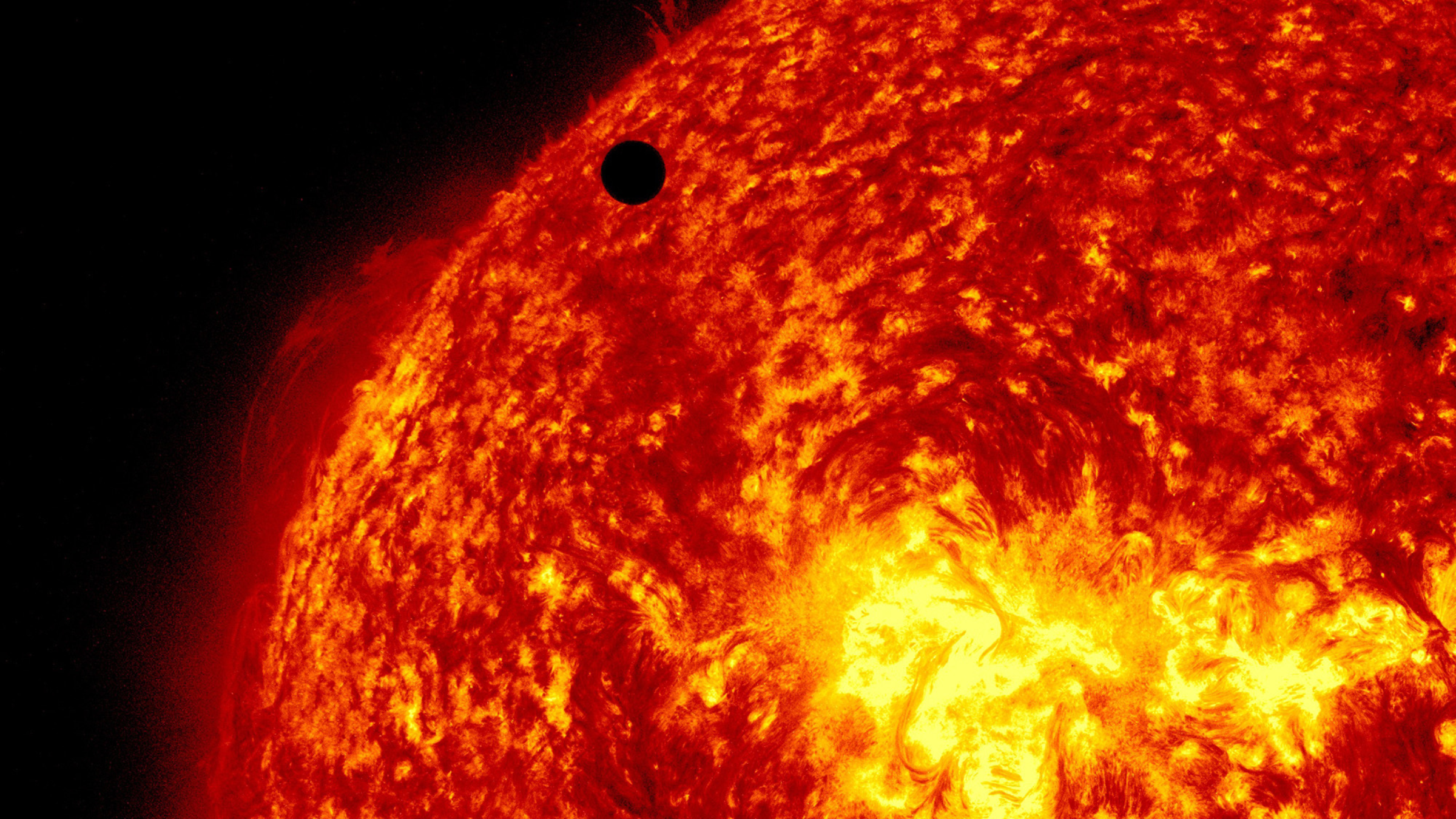
While Mercury orbits closest to the sun, Venus actually maintains significantly higher surface temperatures—900 degrees Fahrenheit compared to Mercury’s 800 degrees. Despite being 31 million miles farther from our star, Venus’s extreme heat results from factors beyond mere proximity to the sun, according to planetary scientists.
The key difference lies in atmospheric composition. Mercury possesses virtually no atmosphere, allowing sunlight to strike bare rock directly during the day before radiating back into space at night, creating temperature swings exceeding 1,000 degrees. Venus, by contrast, is shrouded in an atmosphere roughly 90 times denser than Earth’s, composed almost entirely of carbon dioxide. This thick blanket traps infrared radiation exceptionally well, keeping surface temperatures relatively constant regardless of the sun’s position.
Counterintuitively, Venus absorbs less total sunlight than Mercury, as dense cloud cover reflects approximately three-quarters of incoming radiation back to space before reaching the ground. However, the carbon dioxide atmosphere repeatedly absorbs and re-emits infrared energy leaving the surface, redirecting heat downward and warming the planet further. Planetary scientists attribute this atmospheric blanket to intense volcanic and tectonic activity throughout Venus’s history, which released vast quantities of greenhouse gases.
This comparison demonstrates a fundamental principle: a planet’s distance from its star represents only the beginning of understanding its climate. Atmospheric properties and heat retention capacity often prove far more influential in determining final surface temperatures.
Originally reported by Livescience →
About the Author