
Mysterious Viper With a ‘Spider’ For a Tail Reveals Another Surprise
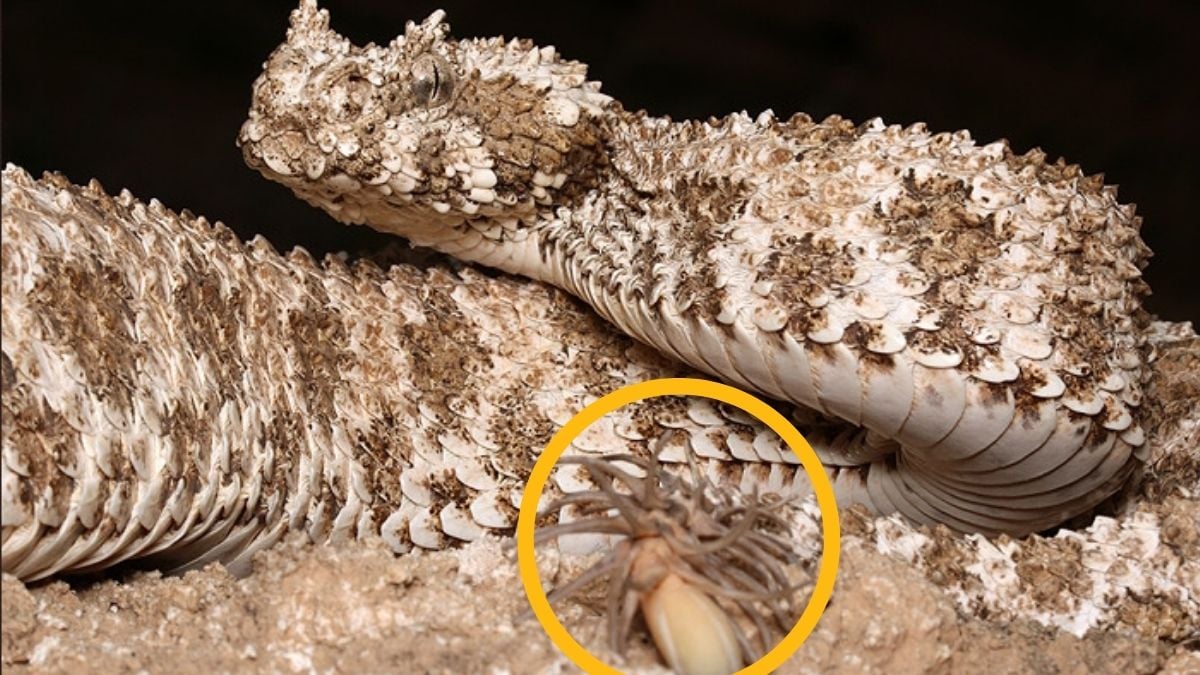 Evolution is nightmare fuel.
Scientists have long been fascinated by the spider-tailed horned viper, an Iranian snake species that possesses one of nature’s most unusual adaptations. The creature, known scientifically as Pseudocerastes urarachnoides, features a tail appendage that bears a striking resemblance to an actual spider, complete with leg-like projections. Researchers have now conducted the most detailed examination of this bizarre snake to date using advanced imaging technology.
A team led by researchers from the Polish Academy of Sciences employed high-resolution micro-CT scanning on a preserved specimen housed at the Field Museum in Chicago to examine the snake’s skeletal structure. The analysis revealed surprising findings about the viper’s distinctive tail. Contrary to expectations, the scans showed no underlying bone structure supporting the spider-like appearance. Instead, the entire appendage is composed of keratin—the same material found in human fingernails—formed through modified scales.
The spider-tailed horned viper uses its deceptive tail as a hunting tool, employing a technique known as caudal luring. The snake remains perfectly camouflaged against rocky terrain while subtly moving its tail to mimic a spider crawling across stones. Unsuspecting birds attempting to capture what appears to be an easy meal become prey themselves. This represents an extraordinary example of evolutionary adaptation, demonstrating how modifications to soft tissue alone can create remarkably realistic mimicry without requiring changes to the underlying skeletal anatomy.
Originally reported by Sciencealert →
About the Author