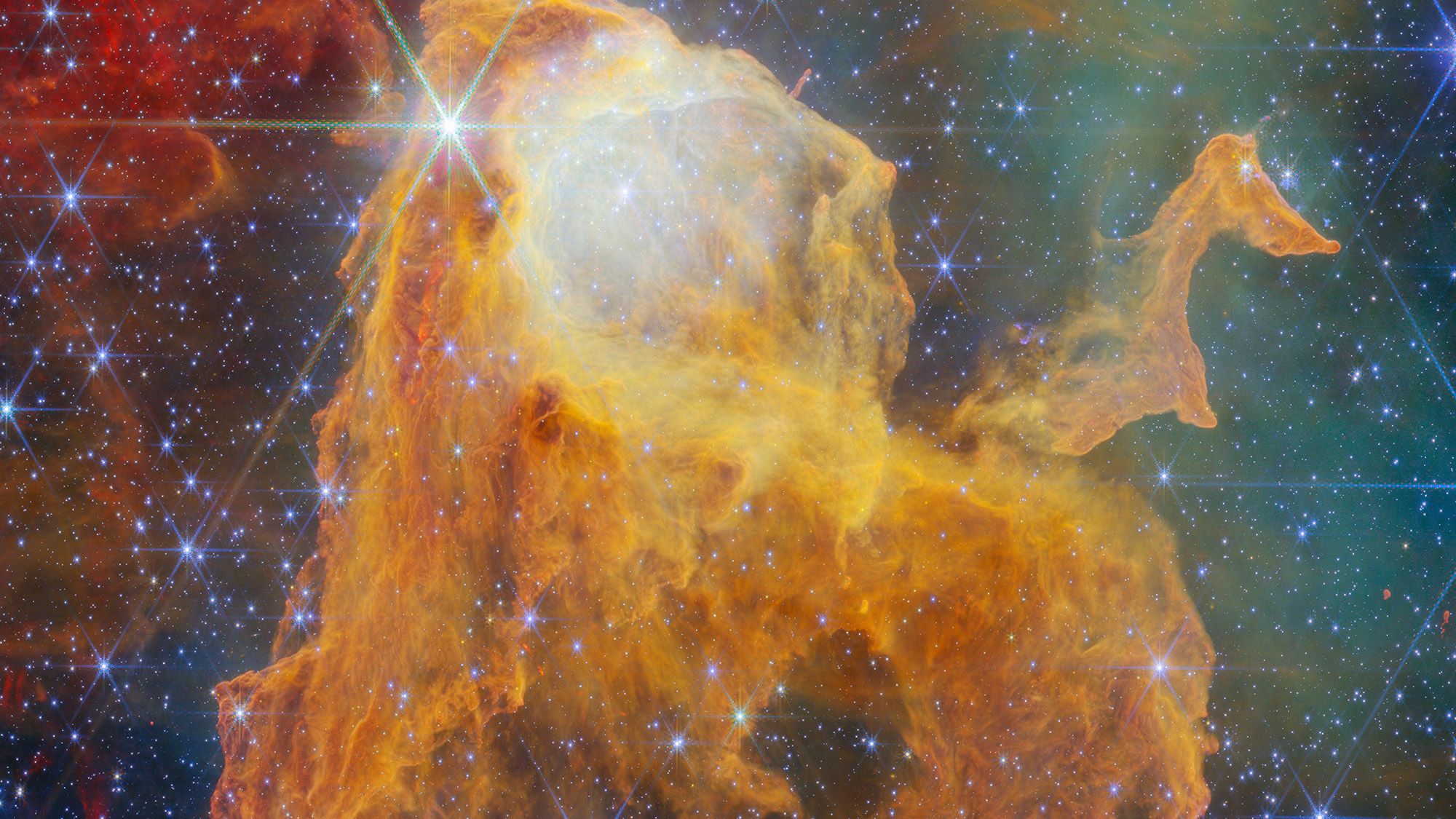
The James Webb Space Telescope has captured a striking image of the Treasure Chest, a distinctive cosmic cloud located approximately 7,500 light-years away within the constellation Carina. This cometary globule, characterized by its dense head and sweeping tail-like structure, resides in the Carina Nebula, one of the Milky Way’s most prolific star-forming regions. The nebula spans roughly 260 light-years and hosts some of the galaxy’s most massive stars alongside tens of thousands of young protostars.
Within the Treasure Chest’s dusty confines lies a remarkable stellar cluster containing approximately 70 young stars. Among these is an exceptionally rare O-type star—an extraordinarily massive and luminous object measuring about 19 times the sun’s mass. Such stars are distinguished by their immense size, brightness, and relatively short lifespans. Scientists estimate the cluster itself is around 1.3 million years old, though earlier assessments suggested ages as young as 100,000 years.
The cloud’s distinctive shape owes partly to its cosmic environment. Eta Carinae, the nebula’s most luminous object situated approximately 39 light-years away, profoundly influences the Treasure Chest’s structure. This binary system, containing a star roughly 100 times the sun’s mass, underwent a dramatic eruption during the 19th century that temporarily made it one of Earth’s brightest visible stars. The intense radiation and stellar winds from Eta Carinae, along with nearby star clusters, continue sculpting the Treasure Chest by gradually dispersing its gas and dust.
Over time, stellar radiation will continue eroding the surrounding material, eventually revealing the hidden stars within. This ongoing transformation will ultimately expose the cluster’s true stellar “jewels” as the cosmic chest dissolves into space.
Originally reported by Livescience →
About the Author