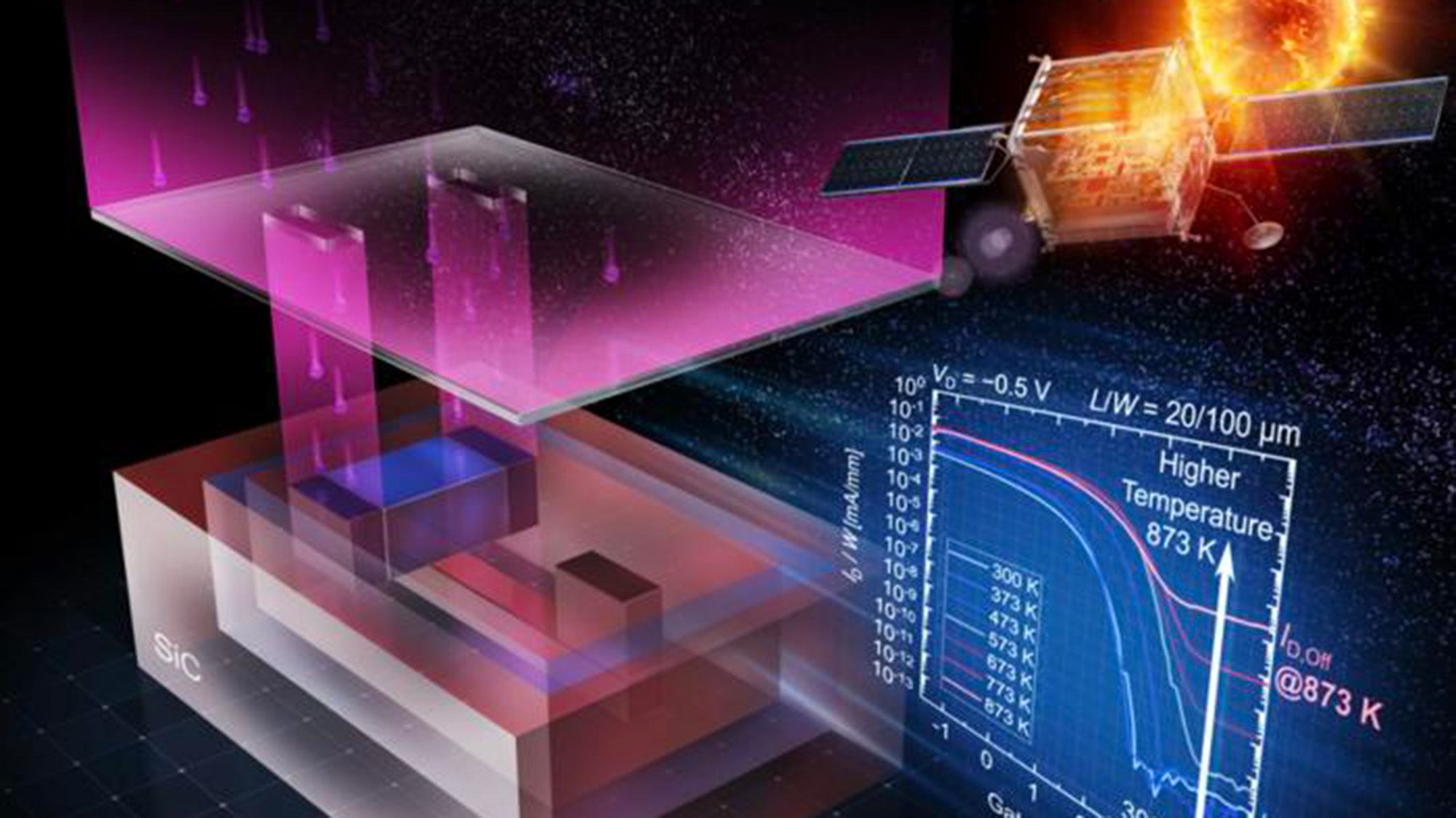
Researchers at Kyoto University have developed a silicon carbide transistor capable of functioning at temperatures exceeding 1,110 degrees Fahrenheit (600 degrees Celsius). This breakthrough could enable the deployment of advanced electronic systems on Venus, where atmospheric conditions reach approximately 860 degrees Fahrenheit (460 degrees Celsius)—temperatures that have historically limited spacecraft operations to mere hours.
The new device is a junction field-effect transistor (JFET) designed to overcome two persistent challenges that had plagued previous high-temperature silicon carbide variants: poor controllability and excessive leakage currents. The team addressed these issues through an innovative bottom-gate configuration and the strategic creation of semiconductor barriers within the silicon carbide material. These design modifications prevent dopant atoms from disrupting the transistor’s electrical properties at extreme temperatures and block unwanted current flow when the device is deactivated.
Testing demonstrated that the transistor maintained stable operation across the full temperature range, with threshold-voltage errors remaining below 0.1 volts at approximately 400 degrees Fahrenheit. Beyond space exploration, such technology could revolutionize aerospace applications by enabling jet engine components to operate at higher temperatures without requiring extensive thermal protection systems and energy-intensive cooling mechanisms.
Before practical deployment, researchers must conduct additional optimization work, including integrating the transistor into complex circuits and testing its durability under realistic conditions. However, prior demonstrations by NASA and other institutions suggest that silicon carbide-based electronics can reliably withstand both extreme temperatures and high pressures for extended periods.
Originally reported by Livescience →
About the Author