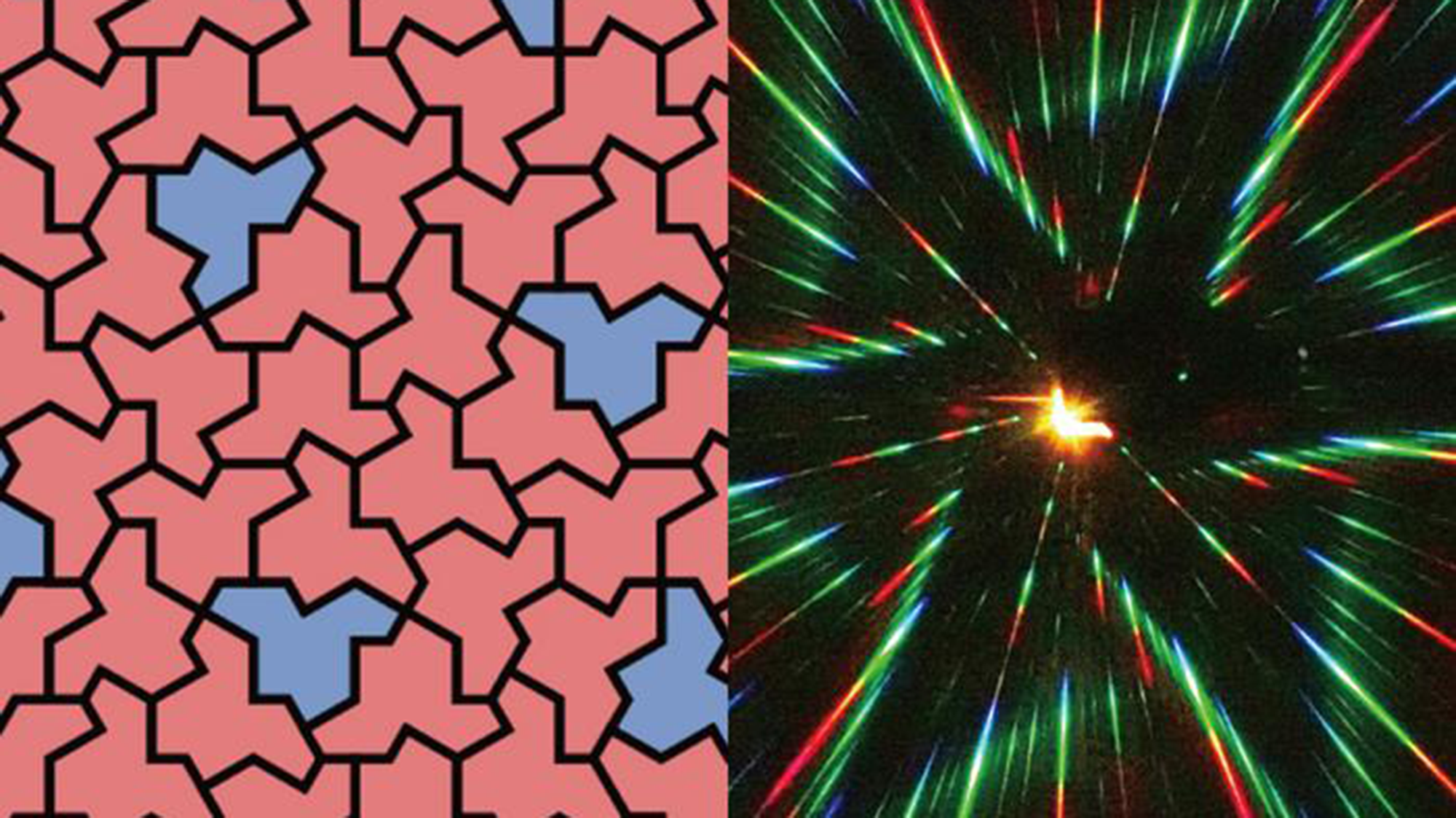
Researchers at the University of Tokyo have successfully created a photonic crystal using an “einstein” tile, a revolutionary 13-sided geometric shape that mathematicians sought for decades. The breakthrough, detailed in a July 2024 publication in Nature Communications, reveals unexpected light-bending properties that distinguish this material from conventional crystals.
The einstein tile, nicknamed the “Smith hat” after its 2023 discovery by David Smith, solves a long-standing mathematical challenge by covering a surface infinitely without repeating its pattern. Physicist Yuto Moritake engineered the crystal by etching hundreds of thousands of microscopic holes into silicon nitride, arranging them according to the tile’s non-repeating design. When exposed to laser light, the structure produced a distinctive pinwheel-shaped scattering pattern with precisely positioned bright spots characteristic of quasicrystals.
The most significant finding emerged from the tile’s asymmetrical geometry. Unlike ordinary quasicrystals, this structure demonstrated different light-scattering responses depending on whether incoming light rotated clockwise or counterclockwise. This chirality-dependent behavior represents a previously undocumented optical property that conventional symmetric crystals cannot achieve.
Moritake plans to advance this research toward practical applications in optical communications and computing, where light manipulation on photonic chips could replace traditional electrical processing. The discovery demonstrates how mathematical solutions to abstract problems can unlock novel physical phenomena with real-world technological potential.
Originally reported by Livescience →
About the Author