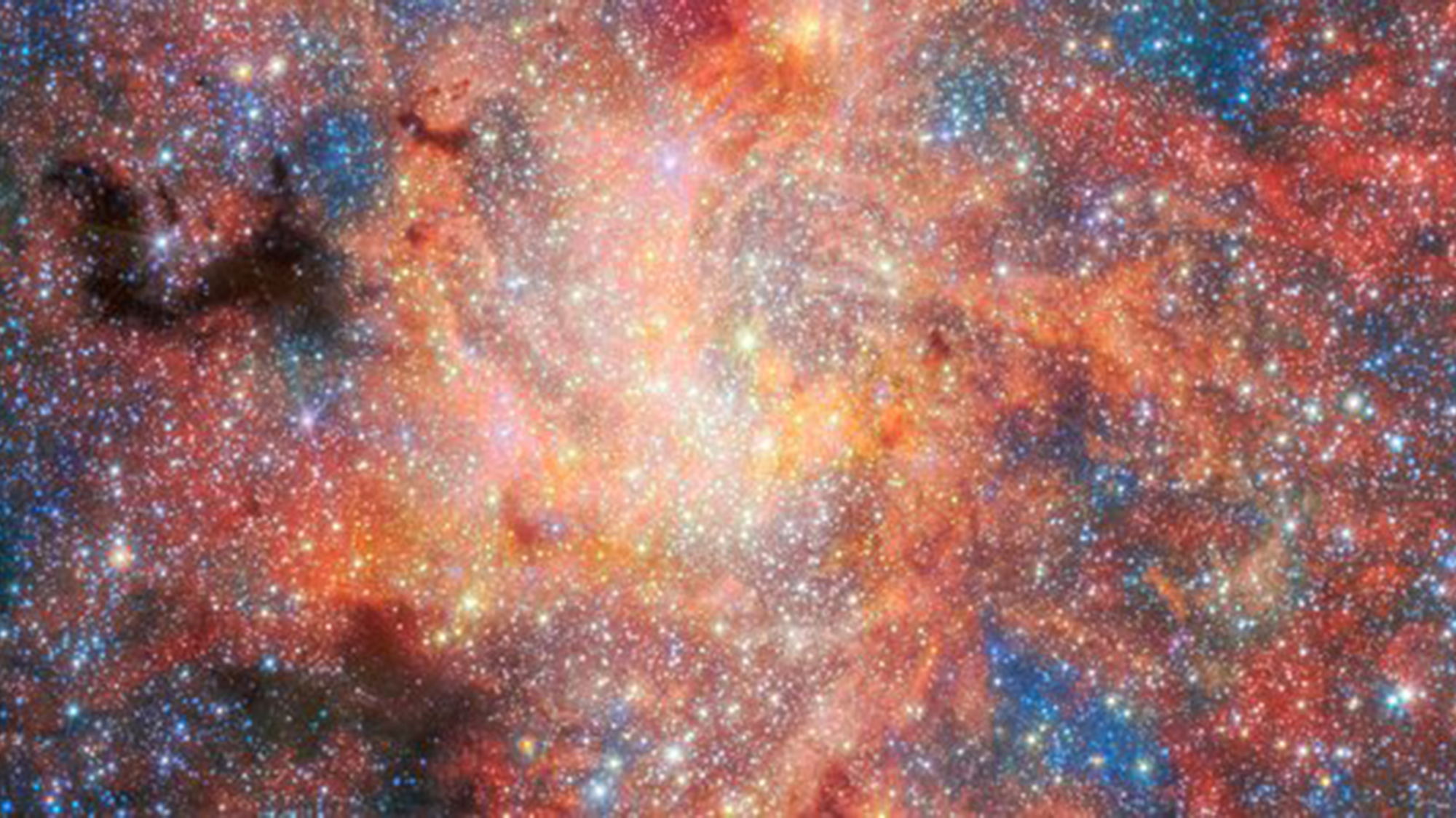
Astronomers have made a remarkable discovery near the center of our galaxy: water exists in the extreme environment surrounding a dying star located close to the Milky Way’s supermassive black hole. The star, known as IRS 3, sits approximately 0.55 light-years from Sagittarius A*, the galaxy’s central black hole, positioned 26,000 light-years from Earth. This represents the first time scientists have detected water molecules in such proximity to a galactic center.
The findings challenge conventional understanding about stellar processes in hostile galactic regions. IRS 3 is an aging star in its late life stage, characterized by enormous size and relatively cool temperatures despite extremely high luminosity. The star continuously sheds vast quantities of gas and dust that form an expansive envelope around it. Using the James Webb Space Telescope’s infrared imaging capabilities, researchers discovered this envelope exhibits a layered, shell-like structure extending roughly 10,000 astronomical units outward, with temperatures ranging from approximately 1,700 degrees Fahrenheit near the star to minus 280 degrees Fahrenheit at its outer edge.
Analysis of the mid-infrared spectral data revealed oxygen-rich silicate dust composition, correcting earlier carbon-based classifications. More significantly, water traces were detected within this envelope despite the intense radiation from the nearby black hole. Researchers estimate IRS 3 possesses approximately six times the sun’s mass with luminosity reaching 60,000 times greater. These observations, published in Astronomy & Astrophysics in August, demonstrate that molecular material can survive galactic center conditions previously thought too extreme for such processes.
Originally reported by Livescience →
About the Author