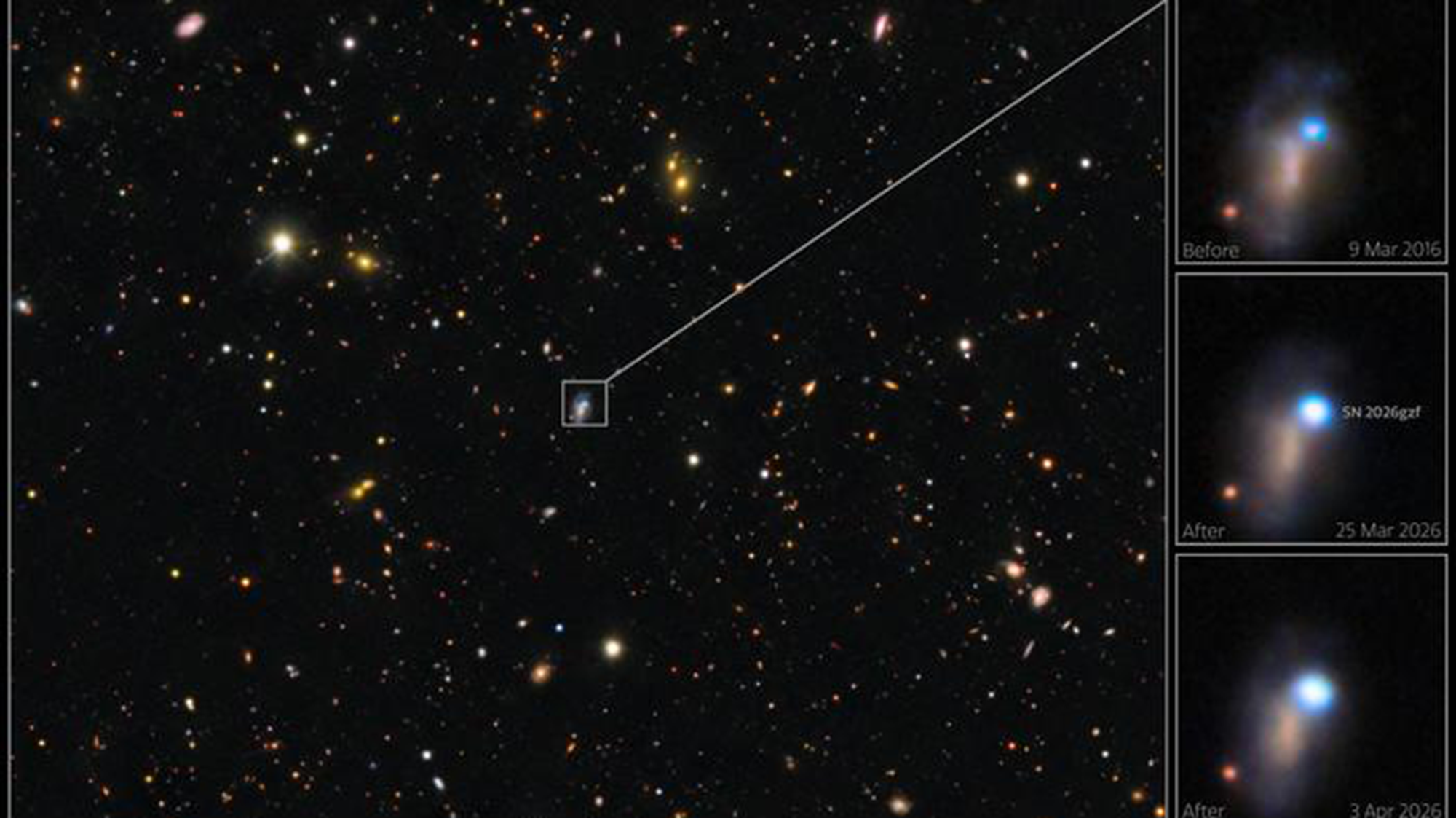
An international coalition of observatories has documented one of the most comprehensive views yet of a stellar explosion occurring 500 million light-years from Earth. The event was initially detected in March by China’s Einstein Probe satellite as a burst of X-rays, prompting ground-based facilities worldwide to rapidly mobilize their instruments for detailed study.
Researchers classified the explosion as a Type Ic broad-lined supernova, originating from a massive star approximately 20 times the sun’s mass. The star, a Wolf-Rayet class object that had shed most of its hydrogen and helium layers before collapse, produced a shock wave visible across multiple wavelengths. Notably, this represents only the second such shock breakout event documented over the past two decades, as these phenomena typically last mere seconds to hours.
The Vera C. Rubin Observatory in Chile played a pivotal role, having been surveying that particular region when the supernova occurred. Follow-up observations from the Gemini telescopes and other facilities revealed surprising characteristics: the shock breakout was dimmer than expected for this supernova type, and no accompanying gamma-ray burst was detected—a finding that challenged prevailing theories about such explosions. Researchers published their findings in two papers in The Astrophysical Journal Letters on July 14.
The coordinated observations allowed scientists to reconstruct the star’s pre-explosion environment and violent history. The extensive dataset promises to provide valuable insights into stripped-mass stellar evolution and the mechanisms driving these catastrophic cosmic events.
Originally reported by Livescience →
About the Author