
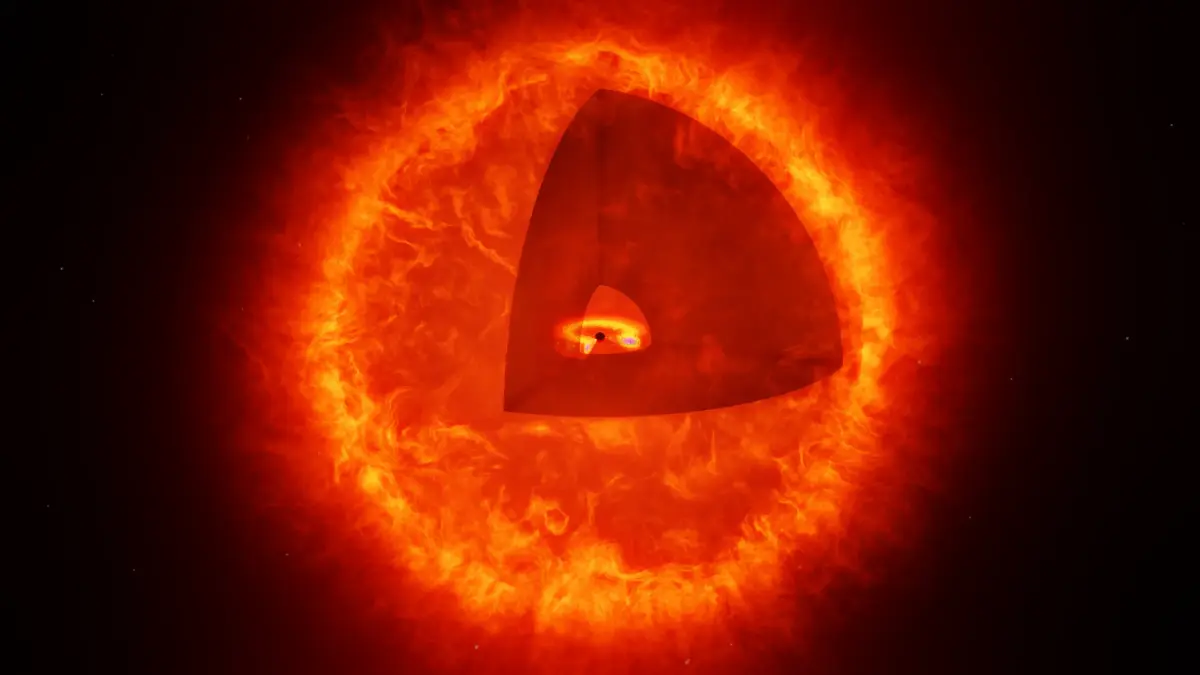
Researchers using NASA’s James Webb Space Telescope have identified what may be the earliest known example of a rapidly growing black hole in the universe. The object, designated MoM-BH*-1, appeared approximately 660 million years after the Big Bang and challenges conventional understanding of how massive black holes form in the early cosmos.
The discovery centers on an unusual celestial phenomenon where nearly all observable light originates from a central black hole surrounded by a dense shell of hydrogen gas rather than from surrounding stars. Through detailed analysis and computer modeling, scientists ruled out alternative explanations involving dust and stellar sources, confirming the black hole as the primary light source. The black hole itself weighs roughly 100,000 times more than our sun and sits within a gas sphere resembling a star the size of our entire solar system.
This finding represents crucial evidence for the existence of “black hole stars,” a theoretical category of cosmic objects that have perplexed astronomers since the James Webb Space Telescope began detecting hundreds of mysterious “little red dots” throughout deep space images. The research suggests these objects may represent a common developmental phase for massive black holes, potentially explaining how supermassive black holes grew so rapidly in the young universe—a longstanding puzzle for cosmologists.
The discovery, published in the journal Nature, offers astronomers a framework for understanding an entire population of peculiar objects scattered throughout the early universe. Scientists believe this mechanism may have been instrumental in the formation of virtually all massive black holes, including the supermassive black hole at the center of our own Milky Way galaxy.
Originally reported by Mashable →
About the Author