
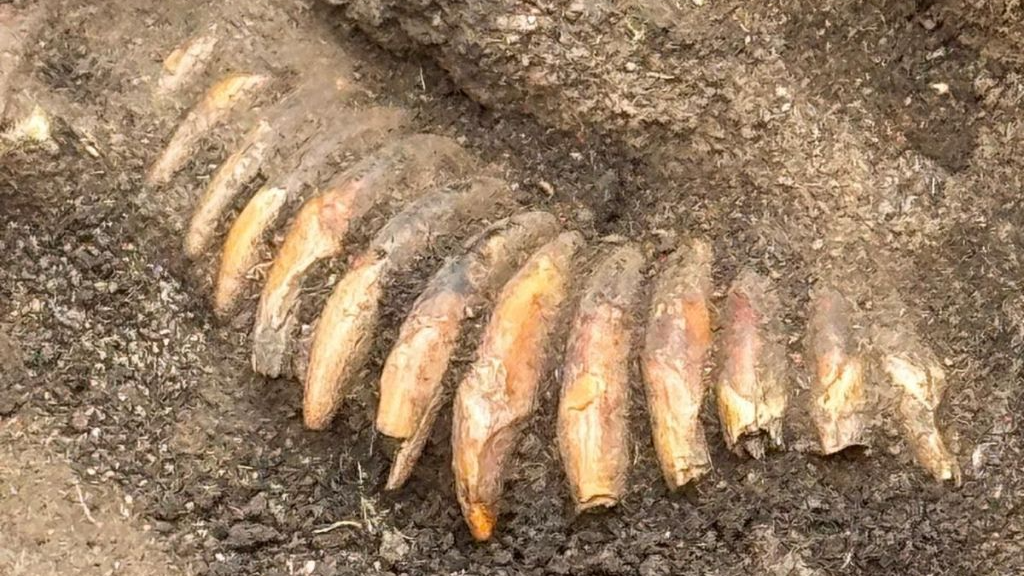
Archaeologists working at a Roman-era cemetery in southwestern Poland made an unexpected discovery: a Stone Age burial containing the remains of an adult male accompanied by extraordinary grave goods. The find, located near Wrocław, dates to approximately 2900 B.C. during the Middle Neolithic period, making it roughly three thousand years older than the Roman site where it was uncovered.
The skeleton was interred with a serpentinite battle ax, amber beads, and a flint blade. Most notably, the grave contained a carefully crafted necklace composed of 42 mammal teeth, each with a drilled hole through its root. According to Paweł Dąbrowski, a biological anthropologist at Wrocław Medical University, the teeth came from large animals including wolves, deer, and bears, suggesting the wearer held significant status within their community.
The burial also included human skeletal remains from two skulls, which researchers believe may represent decapitated heads offered as funeral gifts, though further analysis is required to confirm this theory. The deliberate placement and quality of grave goods led researchers to conclude this individual was likely a prominent figure, possibly a clan leader, warrior, or hunter. A similar elite burial was previously discovered in the same region, suggesting these may represent members of the Corded Ware culture, an ancient civilization credited with spreading Indo-European languages across Europe and Asia.
Researchers plan to conduct additional analysis on both Stone Age burials to determine potential family relationships and gain insights into lives lived nearly five thousand years ago.
Originally reported by Livescience →
About the Author