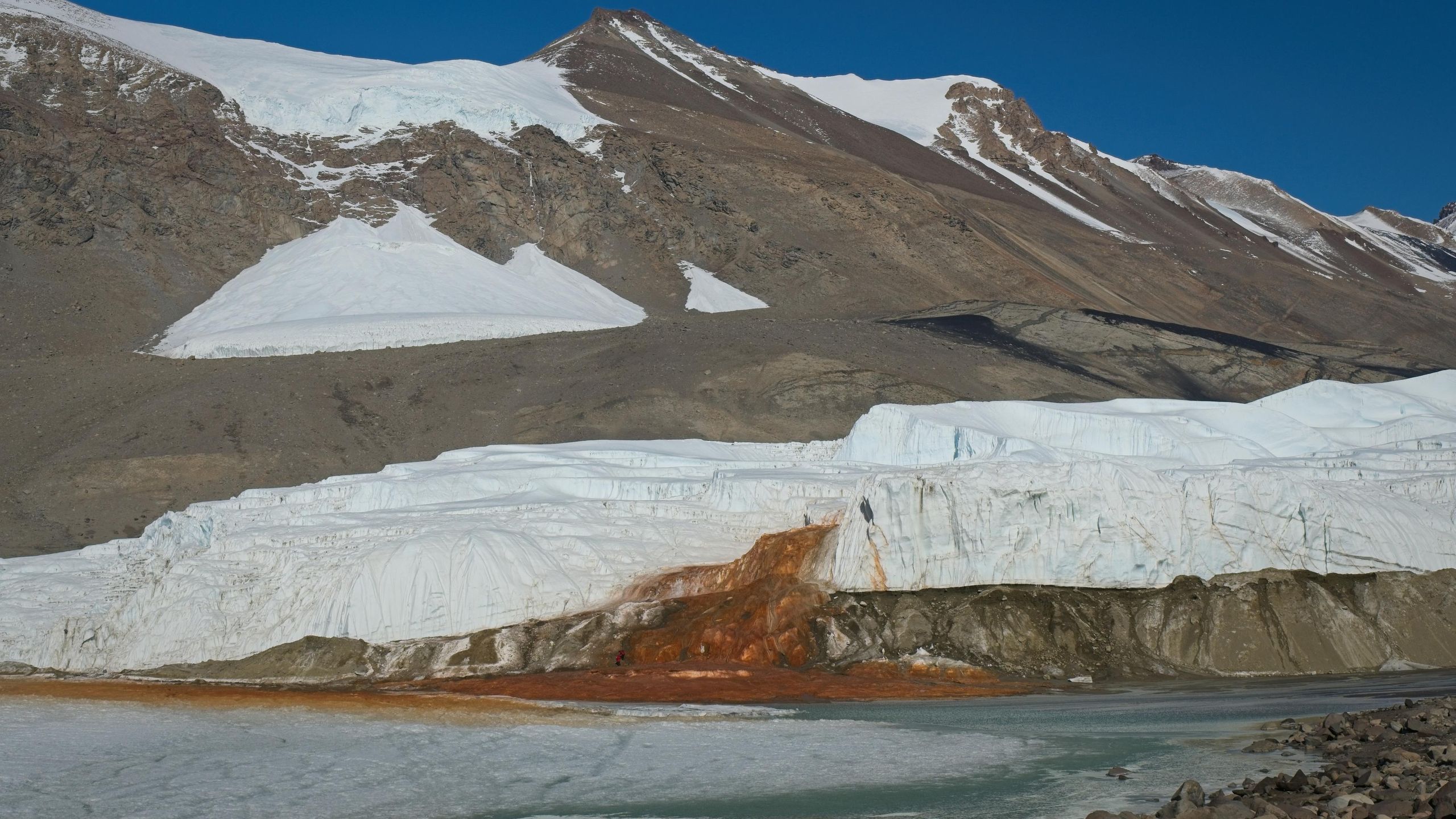
Researchers have identified a significant clue regarding the origins of Blood Falls, a striking red waterfall located beneath a glacier in East Antarctica’s Taylor Valley. The distinctive crimson coloring comes from iron-rich salt water, and scientists now believe this brine consists of seawater that became trapped in a subglacial pool when ocean levels receded and the Taylor Glacier expanded. While the exact timing of this entrapment remains uncertain, the new findings add molecular and genetic support to earlier theories about the waterfall’s composition.
To determine the brine’s source, researchers examined microorganisms from 167 samples collected around Blood Falls and the surrounding McMurdo Dry Valleys. Their analysis revealed a notably higher proportion of marine eukaryotes—organisms with membrane-bound nuclei—at Blood Falls compared to other regional sites. Specifically, Blood Falls contained approximately 9% of its eukaryotes in common with oceanic samples, while nearby areas in the Dry Valleys showed only about 1% similarity, suggesting a distinct marine connection unique to the waterfall.
The team also evaluated whether present-day winds could explain the marine microbial composition at Blood Falls. Testing air samples near the falls revealed only minimal quantities of ocean-derived microorganisms, effectively ruling out wind as the primary source of these organisms. Based on these results, researchers concluded that ancient seawater trapped more than 1 million years ago represents the most probable origin for Blood Falls’ distinctive brine and its associated microbiota.
Originally reported by Livescience →
About the Author