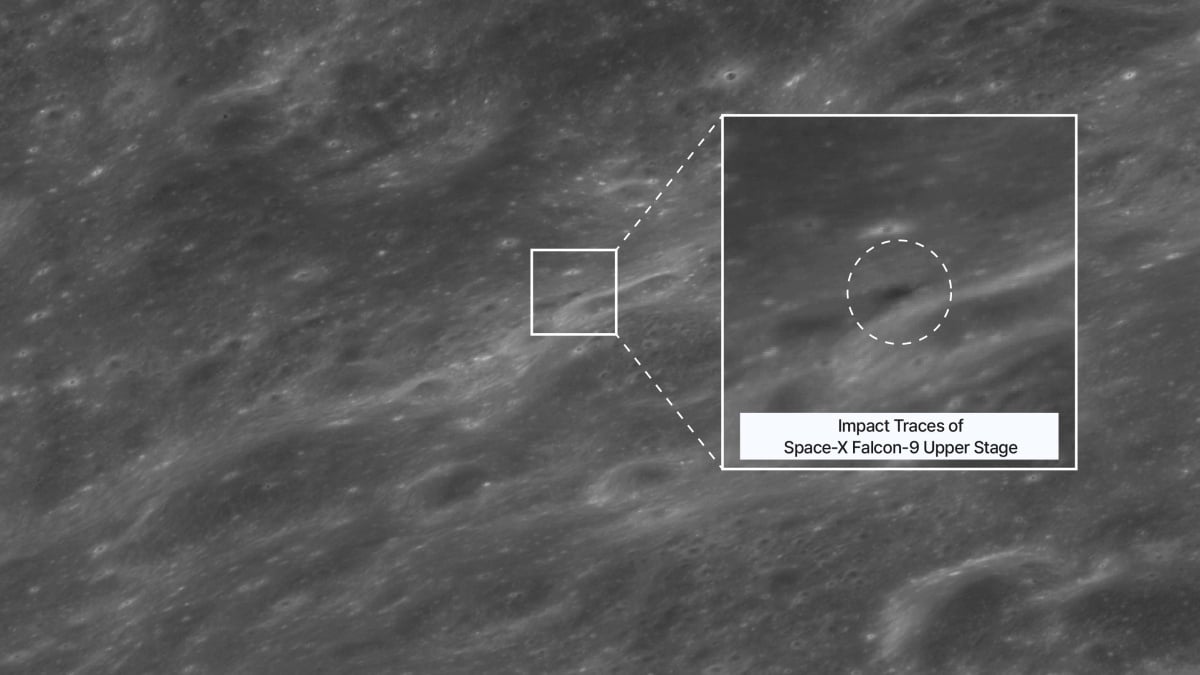
A South Korean lunar orbiter successfully documented the aftermath of an unintended collision when a SpaceX rocket struck the moon’s surface on August 5. The Danuri orbiter, operated by the Korea Aerospace Research Institute, captured multiple images of the impact site near Einstein Crater by positioning itself to observe the area approximately 30 minutes before the Falcon 9 upper stage made contact at 2:34 a.m. ET. The spacecraft completed eight separate photographs documenting terrain changes and debris patterns resulting from the high-speed impact.
The roughly 4-ton rocket stage had drifted through space for over a year following its January 2025 launch from Cape Canaveral, which carried two private lunar landers. Solar activity and gravitational forces gradually altered its trajectory, making the collision unavoidable despite SpaceX’s efforts to coordinate with NASA on responsible disposal methods. Ground-based astronomers supplemented the orbiter’s documentation by detecting material plumes using Chile’s Very Large Telescope, while independent trackers confirmed the rocket reached its predicted destination.
The impact provides researchers with valuable data for understanding how celestial collisions reshape the lunar landscape. Scientists plan to combine the South Korean orbiter’s images with forthcoming photographs from NASA’s Lunar Reconnaissance Orbiter to support international studies of impact mechanics. The incident has raised concerns about accumulating space debris as lunar exploration accelerates, with NASA planning increased robotic missions and private companies developing spacecraft for future human exploration of the moon.
Originally reported by Mashable →
About the Author