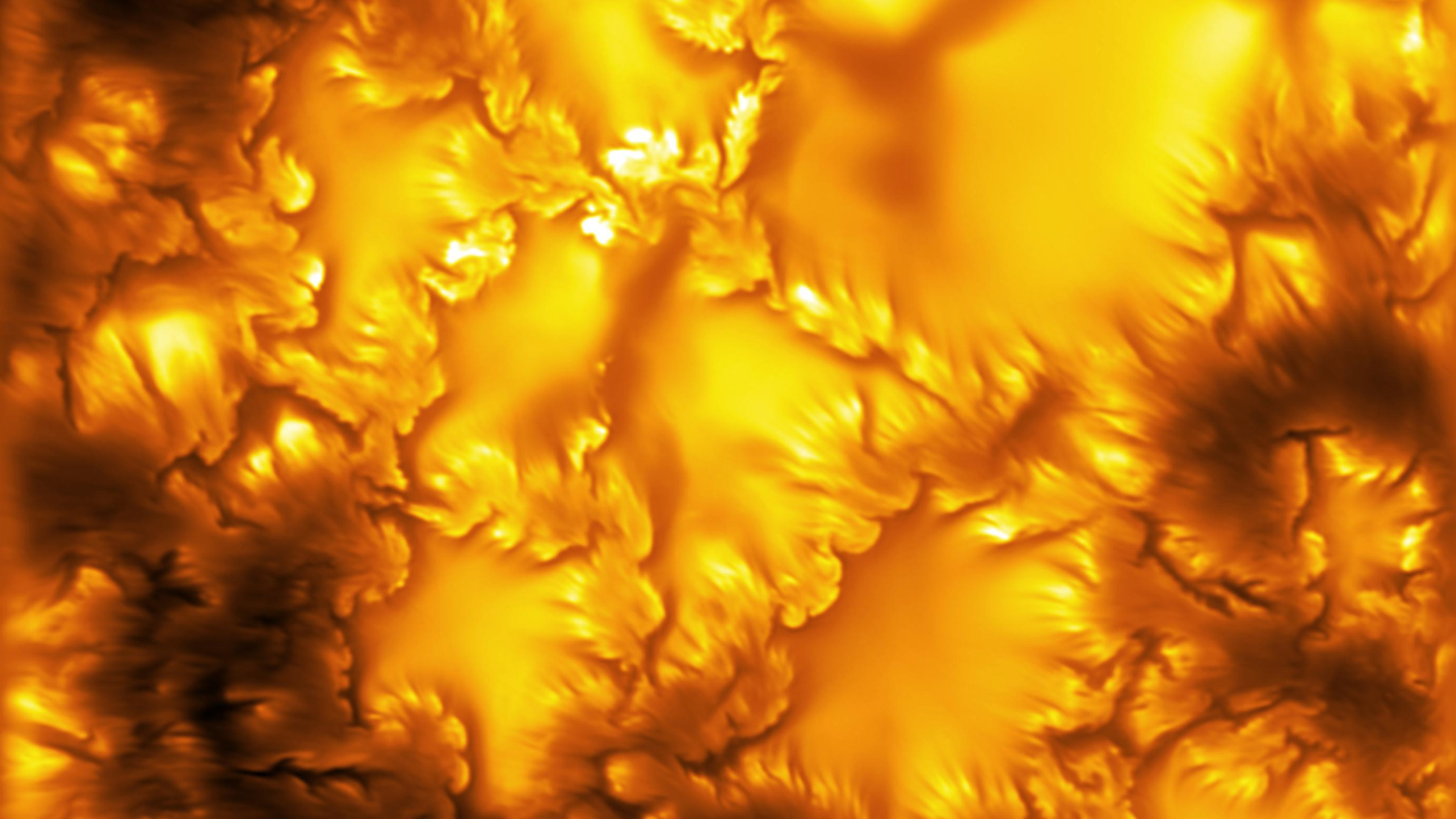
Researchers using the world’s most powerful solar telescope have captured unprecedented images revealing thousands of spiral formations swirling across the sun’s surface. These miniature vortices, which had remained undetected for over a century, were finally made visible through the exceptional resolution of the Daniel K. Inouye Solar Telescope in Hawaii. The groundbreaking observations were published in Nature in August.
The spiraling patterns represent the first direct visual confirmation of a phenomenon known as Kelvin-Helmholtz instability, a concept theorized by 19th-century physicists. This effect occurs when two fluids moving at different speeds create friction that generates rotating vortices. On the sun, this process unfolds between adjacent streams of plasma along the surface, with individual swirls measuring only tens of miles across.
Scientists believe these formations may play a crucial role in understanding the sun’s most dramatic events. The twisting vortices could contribute to the buildup of energy responsible for solar flares and coronal mass ejections. Additionally, researchers suggest the mechanism might help explain why the sun’s outer atmosphere reaches temperatures millions of degrees hotter than its surface—a long-standing mystery in solar physics.
Researchers plan to employ automated tracking systems to monitor these vortices in future observations. This approach will enable precise measurements of how significantly these swirls influence coronal heating and the violent space weather phenomena that can affect satellites and infrastructure on Earth.
Originally reported by Livescience →
About the Author