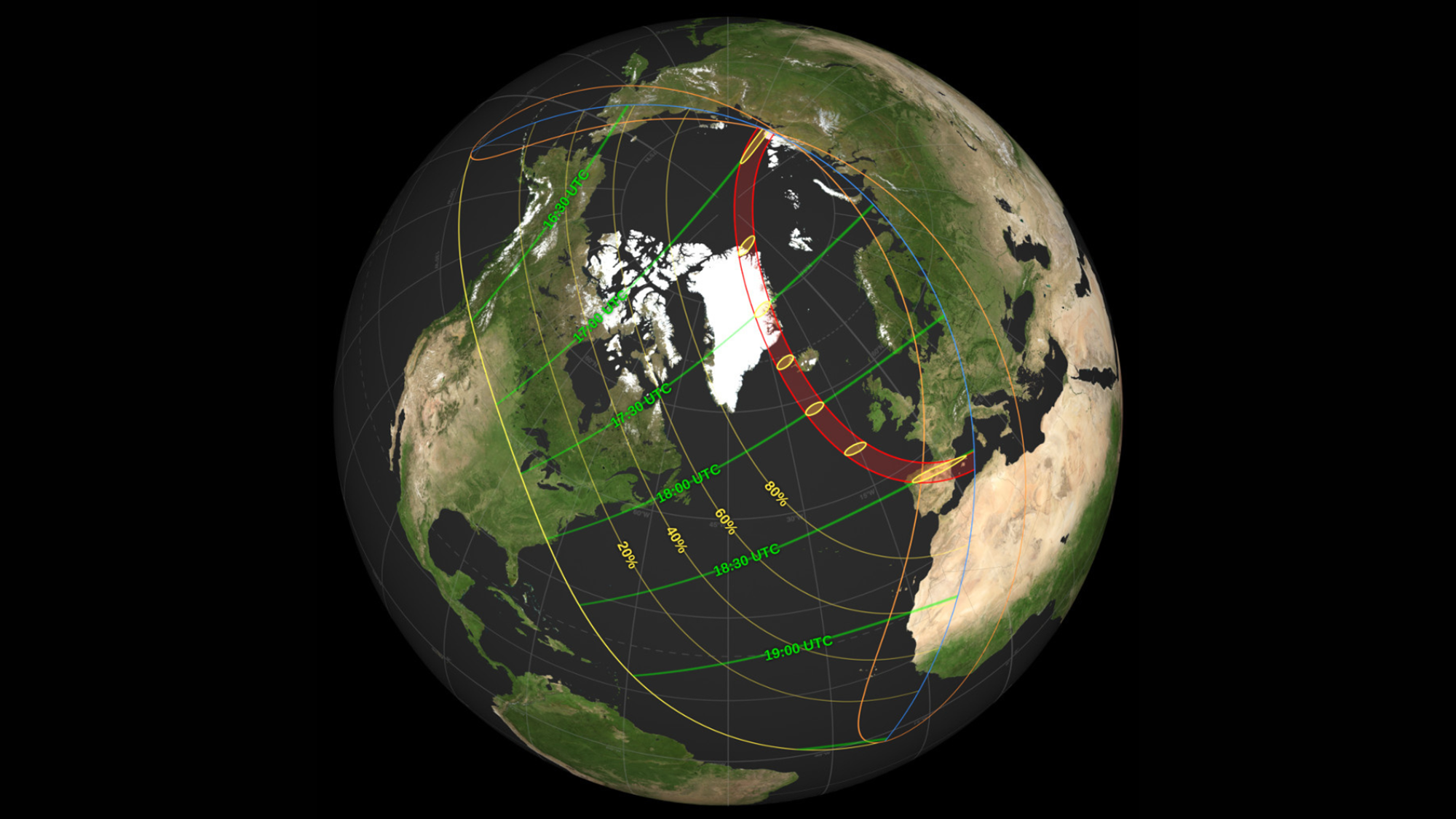
The upcoming total solar eclipse on August 12, 2026, presents a peculiar visual puzzle when viewed on standard flat maps. The moon’s shadow appears to travel backward, beginning in northern Siberia and moving toward Greenland before curving over Iceland and Spain. This counterintuitive pattern has sparked confusion among observers planning to witness the celestial event.
The illusion stems from map projection distortion rather than any actual reversal in the eclipse’s path. All total solar eclipses naturally move from west to east as the moon’s shadow sweeps across Earth’s surface faster than the planet rotates beneath it. In this case, the eclipse passes so close to the North Pole that the curved geometry of Earth becomes severely distorted when represented on a flat surface, creating the false impression of backward motion.
According to NASA’s Scientific Visualization Studio, the August 2026 eclipse follows a unique trajectory due to the combined effects of Earth’s rotation and the tilted orbits of both Earth and the moon. These factors produce a strong north-south component that, when combined with Earth’s eastward rotation, effectively cancels the shadow’s eastward motion during the first portion of its journey. The result is a broad arc across the Arctic rather than the typical west-to-east path.
Those planning to observe the eclipse should take proper precautions, including certified solar eclipse glasses for viewing the partial phases. Only during the moment of complete totality is it safe to view the sun directly without protection.
Originally reported by Livescience →
About the Author