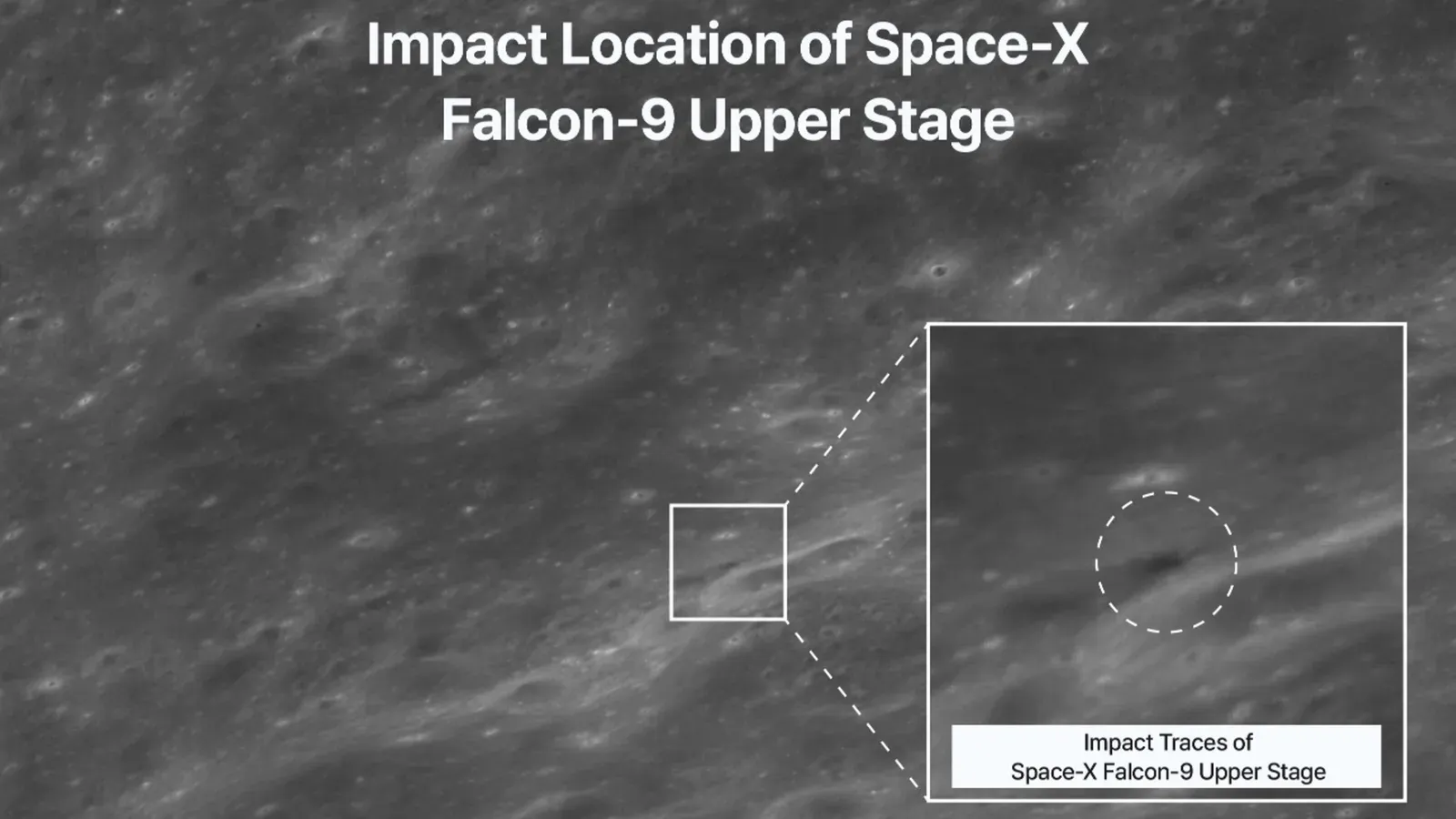
A discarded SpaceX rocket component collided with the lunar surface early Wednesday morning at approximately 5,400 miles per hour, leaving a visible mark on the moon’s landscape. South Korea’s Danuri orbiter captured the first photographs of the impact site, revealing a darkened depression near Einstein crater on the moon’s northwestern region. The Korea Aerospace Administration released these images publicly on Thursday, providing the earliest visual documentation of the collision.
The crashed object was the upper stage of a Falcon 9 rocket that launched in January 2025 carrying lunar landers for two private companies. Unlike the reusable lower stages of Falcon 9 rockets, upper stages are typically abandoned in space after completing their missions. This particular stage spent nearly a year drifting in orbit before gravitational forces from the moon and solar radiation altered its trajectory, putting it on a collision course with the lunar surface.
Scientists had predicted the impact would create a crater approximately 90 feet in diameter, though precise measurements have not yet been released. Researchers note that studying human-made impacts provides valuable information about lunar composition and helps assess potential hazards for future human missions. As space exploration activities increase, understanding these artificial impacts becomes increasingly important for ensuring the safety of astronauts and permanent lunar facilities.
Originally reported by Livescience →
About the Author